
- Xi’an transport at a glance
- Metro: the lines you will actually use
- Getting from Xi’an Xianyang Airport (XIY) into the city
- Getting to and from the railway stations
- Getting to the Terracotta Army
- Bus: cheap, everywhere, mostly Chinese
- Taxi: how to use one without Chinese
- DiDi: the easiest option for most first-timers
- Paying with Alipay or WeChat: how to ride by QR code
- Practical tips
- Frequently asked questions
Short answer: in Xi’an, use the metro first, buses second, and DiDi or a taxi for late nights, bad weather, or anywhere the metro does not reach. The metro is bilingual, cheap, and covers the Bell Tower, the City Wall, the Big Wild Goose Pagoda and both main railway stations. Buses fill the gaps — including the famous bus to the Terracotta Army — and DiDi removes the language problem entirely, because you type the destination in English and the driver follows the app. This guide explains each option in the order a first-timer will actually use it, with the station names to look for and the payment method that works for foreigners.
For the sights themselves — what to see, in what order, and how to book tickets — see our Xi’an Terracotta Army Guide. This article is only about getting around the city.
Xi’an transport at a glance
| Mode | Best for | Typical cost (range) | Watch out for |
|---|---|---|---|
| Metro | Almost everything in the city | About ¥2–9 per ride, by distance | Last trains around 23:00–23:30; check the station display on the day |
| Bus | Places the metro misses, and the Terracotta Army | Usually ¥1–2 per ride; tourist bus 5 (306) about ¥7 | Route maps are mostly Chinese; use a map app |
| Taxi | Short hops, luggage, late nights | Starting fare about ¥8–10 for the first 2–3 km, then about ¥2–2.3 per km; night surcharge applies | Always insist on the meter; avoid unmetered offers at stations |
| DiDi | Door-to-door, no Chinese needed | Similar to a taxi, sometimes slightly higher at peak times | Set the pickup point precisely; drivers may call — see below |
Metro: the lines you will actually use
Xi’an Metro (also called Xi’an Rail Transit) now has more than a dozen lines, but a first-timer needs only four or five of them. Signs and announcements are in Chinese and English, and the line number and colour are shown on every platform, so you can navigate by number alone even if you cannot read a single Chinese character. Trains generally run from about 06:00 to about 23:00–23:30, depending on the line — check the last-train time on the station display before a late evening out, as it varies by station and direction.
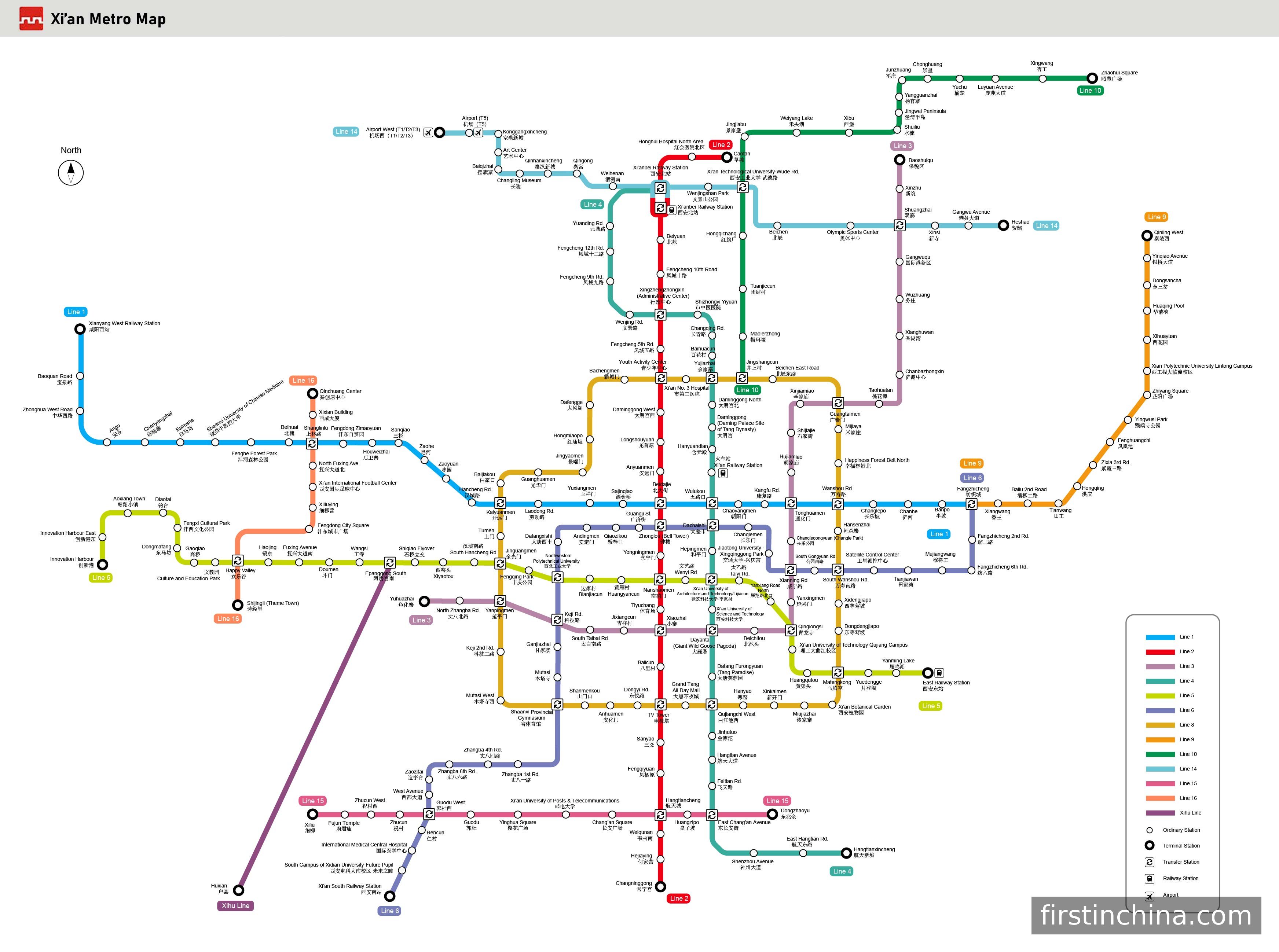
| Line | What it does for a first-timer | Key stations |
|---|---|---|
| Line 2 (red) | The north–south spine through the centre | Xi’an North Station (Xi’an Beizhan) → Beidajie → Bell Tower (Zhonglou) → Yongningmen (south gate of the City Wall) → Xiaozhai |
| Line 1 (blue) | The east–west line across the centre | Beidajie (change to Line 2) → Wulukou → Chaoyangmen → Fangzhicheng (change to Lines 6 and 9) |
| Line 3 (purple) | The pagoda and museum side of the city | Xiaozhai (change to Line 2) → Big Wild Goose Pagoda (Dayanta) → Qinglong Temple |
| Line 4 (teal) | North station to the pagoda area | Xi’an North Station → Daming Palace → Xi’an Railway Station → Big Wild Goose Pagoda (Dayanta) |
| Line 6 (light blue) | The Muslim Quarter side | Bell Tower (Zhonglou) → Qiaozikou, a short walk from the Muslim Quarter lanes |
| Line 9 (orange) | Towards the Terracotta Army direction | Fangzhicheng (change from Line 1) → Huaqingchi (Huaqing Palace), then a short bus or taxi to the museum |
| Line 14 (light teal) | The airport line | Airport West (T1/T2/T3) and Airport (T5) → Xi’an North Station (change to Lines 2 and 4) |
How to ride: buy a single-journey token from the ticket machine (choose English on the screen, pick your destination, pay by cash or mobile payment), or scan a QR code — see Paying with Alipay or WeChat below. Put your bags through the security scanner at the entrance, tap or insert your token at the gate, and keep the token: you need it to exit at the other end. If you use a QR code, hold it over the scanner at the gate in and out. On the platform, follow the direction shown by the terminal station name, not just the line number — Line 2, for example, runs both north to Caotan and south to Changninggong.
Getting from Xi’an Xianyang Airport (XIY) into the city
Xi’an’s only passenger airport is Xi’an Xianyang International Airport (XIY), about 35–50 km north-west of the centre depending on the route. International flights now use Terminal 5, which has its own metro station, while Terminals 1, 2 and 3 share the Airport West station — follow the signs for your terminal’s station.
| Option | Route | Time and cost (range) | Best for |
|---|---|---|---|
| Metro Line 14 | Airport → Xi’an North Station, change to Line 2 for the Bell Tower | About 60–80 minutes to the Bell Tower area in total; about ¥8–9 | Most first-timers, daytime arrivals |
| Airport shuttle bus | Several lines to the Bell Tower area, Xi’an Railway Station and the high-tech zone | About 60–90 minutes; about ¥25 | Hotels near a shuttle stop; heavy luggage |
| Taxi / DiDi | Door to door | About 40–60 minutes without heavy traffic; roughly ¥100–200 depending on destination and traffic — check the meter or the app price before you go | Late arrivals, groups, lots of luggage |
Note that the Line 14 to Line 2 change at Xi’an North Station can involve a longer walk than a normal interchange, so allow extra time with luggage. If your flight lands late, check the last metro train before you commit to the metro — the shuttle bus and taxi/DiDi run later.
Getting to and from the railway stations
Xi’an North Station (Xi’an Beizhan) is the main high-speed hub and the station most first-timers will use. It is on metro Lines 2, 4 and 14, so you can reach the Bell Tower area on Line 2 without a taxi. Xi’an Railway Station, near the city centre, is on Line 4 and mainly handles conventional trains — it is also where tourist bus 5 (306) to the Terracotta Army leaves from (see below). Xi’an East Station, which opened on 30 June 2026, serves newer high-speed routes towards Wuhan, Shiyan and Ankang and connects to Line 5 — do not assume every high-speed train uses Xi’an North. The rule that saves every first-timer trouble is the same in every Chinese city: go to the station name printed on your ticket. Xi’an North, Xi’an Station and Xi’an East are far apart, and a ticket for one is not valid at another.
Getting to the Terracotta Army
The Terracotta Army museum is about 40 km east of central Xi’an, in Lintong District. It is a half-day trip, not a city-centre sight, so plan transport in both directions before you leave. For tickets, timing and what to see inside, see the Terracotta Army section of our Xi’an guide — this section is only about how to get there.
| Option | How it works | Time and cost (range) |
|---|---|---|
| Tourist bus 5 (306) | From the east square of Xi’an Railway Station (not Xi’an North) to the museum’s final stop; stay on until the last stop | About 60–75 minutes; about ¥7. Ignore touts at the station selling “official” alternatives — use the designated bus 5 stop, and pay on board as the conductor comes round |
| Metro + bus | Metro Line 1 or 4 to Fangzhicheng, Line 9 to Huaqingchi, then a short local bus (such as bus 602) to the museum | Longer, but avoids the railway station crowds; fares are metro fare plus a short bus fare |
| DiDi / taxi | Door to door from your hotel | About 40–60 minutes each way; about ¥120–150 one way. Agree a return pickup point before you enter the museum, or book the return in the app while you are inside |
| Guided tour | Hotel pickup, usually including Huaqing Palace | Half a day; price varies by operator — check what is included before booking |
Bus: cheap, everywhere, mostly Chinese
Xi’an has hundreds of bus routes, and they reach streets and suburbs the metro does not. Most city buses cost about ¥1–2 per ride, flat fare, and you pay when you board — by transport card, QR code, or exact-change cash (drivers do not give change, so carry small notes and coins). The catch for a foreign visitor is that bus stop names and route maps are mostly in Chinese, and buses do not announce stops in English as reliably as the metro does. The practical way to use buses is: plan the route in a map app (Amap/Gaode or Baidu Maps) before you board, save a screenshot of the stop names, and count stops. Use buses for short, simple trips — one bus, no change — and use the metro or DiDi for anything complicated. Night buses run on some routes, but far less frequently; check the app on the day rather than assuming a night service.
Two bus numbers are worth memorising: bus 5 (306) to the Terracotta Army (above), and bus 609, which serves the Giant Wild Goose Pagoda and Shaanxi History Museum area. Both are used by tourists, so drivers and fellow passengers are used to visitors asking — show the destination in Chinese characters on your phone if you are unsure.
Taxi: how to use one without Chinese
Xi’an taxis are green or yellow, metered, and easy to hail on main streets outside rush hour (roughly 07:30–08:30 and 17:30–19:00 are hardest). The starting fare is about ¥8–10 for the first 2–3 km, then about ¥2–2.3 per kilometre, with a night surcharge of about 20% between about 23:00 and 06:00 — sources differ slightly on the exact flagfall, so treat these as ranges and read the meter. Three rules keep taxi rides painless: (1) always insist on the meter — if the driver refuses or quotes a flat price, get out and take the next taxi; (2) show the destination in Chinese characters from your hotel confirmation or a map app, because most drivers do not speak English; (3) keep the receipt from the meter printout, which has the taxi’s number if you leave something behind. Pay by cash or by scanning the QR code shown in the taxi with Alipay or WeChat Pay. At railway stations and the airport, use the official taxi queue, not drivers who approach you inside the terminal.
DiDi: the easiest option for most first-timers
DiDi is China’s main ride-hailing app, with an English interface, foreign phone registration and international card payment. You type the destination in English, the app shows the price before you confirm, and the driver follows the app’s navigation — no Chinese conversation is needed. For the full step-by-step setup, car types and payment options, see our How to Use DiDi in China; the short version for Xi’an is: set your pickup point precisely (hotel name in English usually works, but the map pin matters more than the name), choose the car type, and if the driver calls, do not panic — they are usually confirming the pickup point, and you can reply with a short message in the app or ask your hotel to speak to them. DiDi is also the best fallback when the metro has stopped, when you have heavy luggage, or when you are heading to the Terracotta Army and want a guaranteed return: book the return ride while you are still inside the museum, before the exit crowds.
Paying with Alipay or WeChat: how to ride by QR code
Foreign visitors can ride Xi’an’s metro and buses without a physical card, by using a transport QR code inside Alipay or WeChat Pay. Set this up before your first ride, while you have Wi-Fi, because it needs a one-time activation.
Alipay: open Alipay → Transport → select Xi’an (the city card is usually called Chang’antong, Xi’an’s transport card) → activate the metro/bus QR code and agree to the terms. At the metro gate, open the code and hold it over the scanner; do the same when you exit. On a bus, scan the code on the reader near the driver when you board. WeChat Pay: open WeChat → Services (or Me → Services) → Transport → select Xi’an and activate the local transport code, then use it the same way. Full setup guides, including what to do if your foreign card is rejected, are in our Alipay guide and WeChat Pay guide.
Alternatives, and limits to know: single-journey tokens from metro ticket machines (English available) work for any one trip and are the simplest fallback if a QR code fails. A physical Chang’antong transport card, sold at metro stations and convenience stores, works on metro and bus and is worth it if you are staying several days. Two warnings: first, a transport QR code is city-specific — a code activated for another city will not work in Xi’an, so activate Xi’an’s code specifically. Second, QR-code availability for foreign cards can change — if activation fails, fall back to single-journey tokens or a physical card rather than assuming it will work at the gate, and check on the day.
Practical tips
- Stay near Line 2. A hotel near the Bell Tower, Yongningmen or Xiaozhai puts the Wall, the Muslim Quarter, the pagoda area and both railway stations within one metro ride.
- Carry the Chinese name of your hotel. Save it as a screenshot, not just in an app — taxi drivers, bus conductors and hotel staff all read Chinese characters faster than pinyin.
- Security checks are normal. Bags go through an X-ray scanner at every metro entrance. Liquids, lighters and large tools may be confiscated — check the station signs if you are carrying anything unusual.
- Rush hour is real. Lines 2 and 3 are packed roughly 07:30–09:00 and 17:30–19:00. If you can, visit the Bell Tower area mid-morning and the pagoda area in the afternoon.
- Walking inside the Wall is a transport choice too. The old city inside the Wall is compact — Bell Tower, Drum Tower, Muslim Quarter and the south gate are walkable from each other, and walking is often faster than a one-stop metro ride plus security and interchange.
- Keep a backup plan for late nights. After the last metro, DiDi is the reliable option; street taxis thin out after midnight outside the centre.
Frequently asked questions
Can I use Alipay or WeChat to ride the Xi’an Metro?
Yes, in most cases — activate Xi’an’s transport QR code in Alipay (Transport) or WeChat Pay (Services → Transport) before your first ride, and scan it at the gates. If activation fails for your foreign card, use single-journey tokens from the ticket machines or buy a Chang’antong card at a metro station.
Which metro line goes to the airport?
Line 14. Take it to Xi’an North Station and change to Line 2 for the Bell Tower area. Allow about 60–80 minutes from the airport to the Bell Tower in total, and check the last train on the day for late arrivals.
Which station do I use for high-speed trains?
Usually Xi’an North Station (Lines 2, 4 and 14). But check your ticket: Xi’an East (opened 30 June 2026) serves some newer routes, and Xi’an Railway Station serves mainly conventional trains. Go to the station printed on your ticket.
Is the bus to the Terracotta Army safe for foreigners?
Yes — tourist bus 5 (306) from the east square of Xi’an Railway Station is the official public bus. Ignore touts selling alternatives, stay on until the final stop, and keep the same stop in mind for the return.
Is DiDi better than a taxi in Xi’an?
For a first-timer, usually yes: the price is shown before you confirm, the destination is typed in English, and payment is in the app. Taxis are fine too if you insist on the meter and show the destination in Chinese characters.
Last updated: October 2026. Metro lines, fares and last-train times change — check the station display, the official Xi’an Metro map, or a map app on the day before you travel. For the city’s sights, see our Xi’an guide, and for getting around Chinese cities in general, see Getting Around China Cities.