
- Nanjing transport at a glance
- Metro: the backbone of getting around Nanjing
- Metro lines visitors actually use
- Bus: cheap, useful for short hops
- Taxi: metered, and the Chinese address is the key
- DiDi: the easiest door-to-door option (summary)
- Paying: Alipay and WeChat QR codes for metro and bus
- Airport and railway stations: getting into the city
- When to use what: a first-timer’s decision guide
- Practical tips and first-timer mistakes
- Frequently asked questions
Short answer: use the metro first, DiDi second, and buses for the last short hop. Nanjing’s metro reaches Lukou Airport, Nanjing South station, Xinjiekou, the Confucius Temple, Purple Mountain and most sights, and it is signed in English and Chinese. You do not need a car, and you do not need to understand Chinese to ride it — you need a working Alipay or WeChat transport code (explained below), the English station name of your destination, and a check of the last train if you are out late. This guide covers the metro, buses, taxis and DiDi in Nanjing, how to pay for each, and how to get from the airport and the railway stations into the city. For the sights themselves, see our Nanjing for First Timers guide.
Nanjing transport at a glance
| Way to travel | Best for | First-timer note |
|---|---|---|
| Metro | Airport, railway stations, Xinjiekou, Confucius Temple, Purple Mountain, most sights | Fastest and easiest. Line S1 serves the airport; Lines 1, 2, 3 and 4 cover the centre. |
| Bus | Short hops, Purple Mountain’s internal shuttle, places just beyond a metro station | Cheap, but slower in traffic and harder to follow without a map app. |
| Taxi | Late nights, heavy luggage, groups, rain | Metered. Have the address in Chinese characters saved on your phone. |
| DiDi | Door-to-door trips when you do not want to explain an address | Best for non-Chinese speakers. See our DiDi guide for the full steps. |
| Walking | Inside each sight area: the wall, the Qinhuai riverfront, Xuanwu Lake | The sights are spread out, so walk inside an area and let the metro do the long hops. |
Metro: the backbone of getting around Nanjing
Nanjing Metro opened in 2005 and now runs more than a dozen lines across the city. You will use only a handful of them as a first-timer, and they are all signed in English and Chinese, with English announcements. Trains generally run from about 06:00 to about 22:30–23:00, depending on the line, with the airport line S1 stopping earlier, at around 22:40 from the airport — always check the last train on the station display on the day, especially after a late dinner or a late flight, because a missed last train means a taxi or DiDi instead. Fares are distance-based and start at about ¥2 for a short ride; a cross-city ride costs more, and the exact fare is shown when you buy a ticket or scan your code, so treat any single figure in a guide as an example, not a current price.
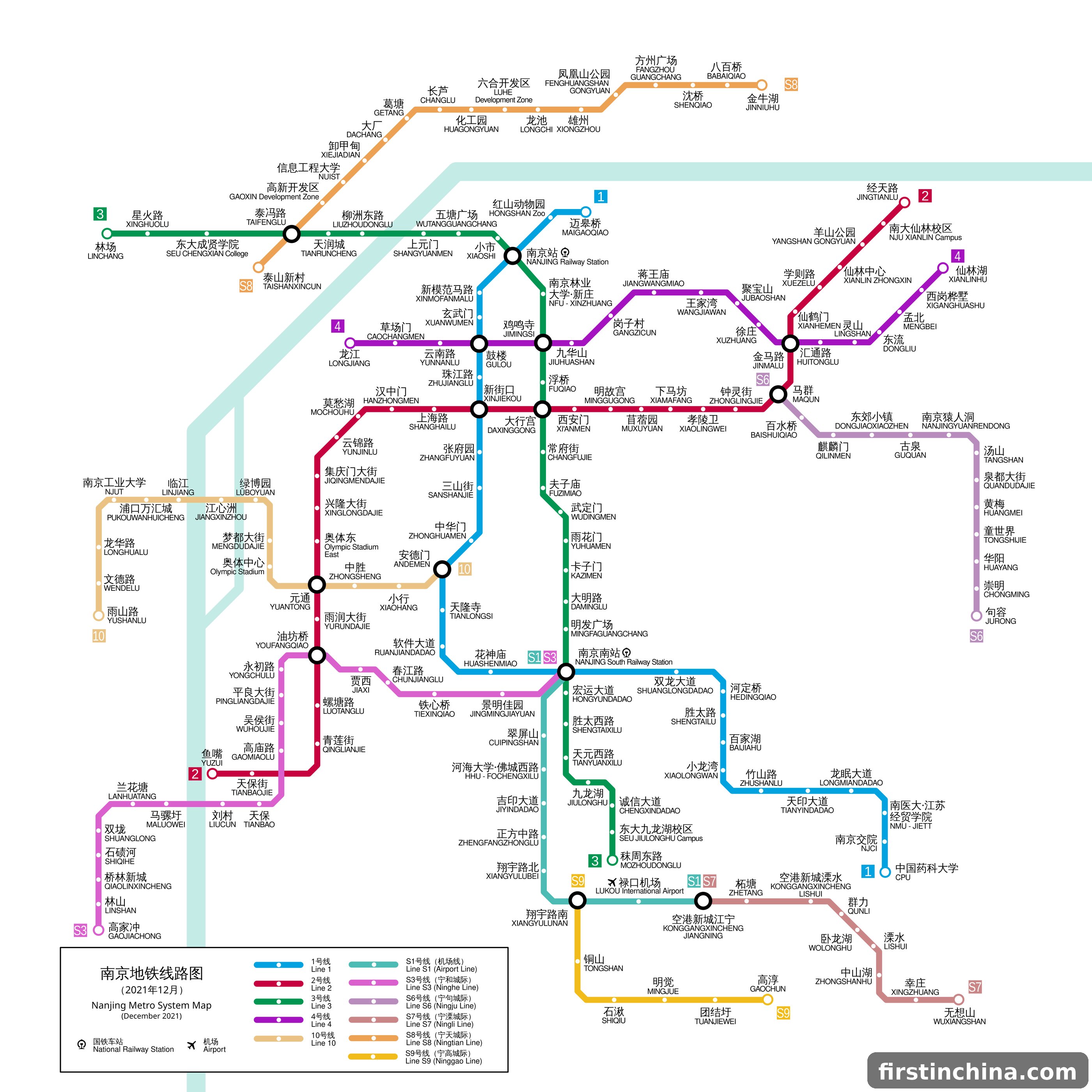
Metro lines visitors actually use
| Line | Useful for first-timers | Key stations |
|---|---|---|
| Line 1 (north–south spine) | City wall south, Xinjiekou, Xuanwu Lake, Nanjing Railway Station, Nanjing South | Zhonghuamen (city wall), Xinjiekou, Xuanwumen (Xuanwu Lake), Nanjing Railway Station, Nanjing South Railway Station |
| Line 2 (east–west spine) | Presidential Palace, Nanjing Museum, Purple Mountain, Memorial Hall | Daxinggong (Presidential Palace), Minggugong (Nanjing Museum), Xiamafang and Muxuyuan (Purple Mountain), Yunjinlu (Memorial Hall), Xinjiekou |
| Line 3 (cross-city) | Confucius Temple, Jiming Temple, both main railway stations | Fuzimiao (Confucius Temple), Jimingsi (Jiming Temple), Daxinggong, Nanjing Railway Station, Nanjing South Railway Station |
| Line 4 (east–west) | Jiming Temple, Gulou area, Xianlin university area | Jimingsi, Gulou, Longjiang, Xianlinhu |
| Line 10 (west) | Hexi and the Olympic sports area, west of the river crossing | Andemen, Yuantong, Yushanlu |
| Line S1 (Airport Line) | Lukou Airport to Nanjing South, then Lines 1 and 3 into the centre | Lukou International Airport, Nanjing South Railway Station |
| Line S3 | West across the Yangtze from Nanjing South; rarely needed by first-timers | Nanjing South Railway Station, Gaojiachong |
Newer lines and extensions have opened since the December 2021 map above, and more are under construction, so the table above is a first-timer’s shortlist, not the full network. If a station you need is not on the map, check the official Nanjing Metro site or a map app on the day rather than assuming the line does not exist. The interchange that matters most is Xinjiekou, where Lines 1 and 2 cross in the shopping centre; Nanjing South, where Lines 1, 3 and S1 meet, is the other hub you will use again and again.
Bus: cheap, useful for short hops
City buses cost a few yuan per ride and cover streets the metro does not reach, including the shuttle buses inside the Purple Mountain scenic area, where walking between the mausoleums takes a long time. The catch for first-timers is navigation: bus stop names are in Chinese, announcements may not be in English, and routes are harder to follow than a metro line. Use a map app (Amap or Baidu Maps, with your destination saved in Chinese characters) and ride the bus only for a short, clearly mapped hop — for example, from a metro station to a sight entrance — rather than across the city. Pay with the same Alipay or WeChat transport QR code as the metro, or with small cash on board where accepted.
Taxi: metered, and the Chinese address is the key
Nanjing taxis are metered, and a metered ride is the only kind you should accept. Have your destination saved in Chinese characters on your phone and show it to the driver — a hotel name card, a screenshot from a map app, or the Chinese name of the sight. Do not accept a fixed price offered by a driver waiting outside an airport, station or tourist sight; walk to the official taxi queue instead. At night, or when a driver refuses the meter, walk away and use DiDi. Keep your hotel’s address in Chinese on your phone for the return journey, since “my hotel near Xinjiekou” is not precise enough for a driver.
DiDi: the easiest door-to-door option (summary)
DiDi is the ride-hailing app most foreign visitors use in China, and it works in English inside Alipay or as a standalone app. Set it up before you need it, enter your destination in English, and pay in the app — no cash and no Chinese needed with the driver. Use it for late-night trips, heavy luggage, rain, and anywhere the metro does not reach conveniently, such as a Purple Mountain site after the scenic buses stop. Do not use it for every short hop in the centre, where the metro is faster and far cheaper. For the full set-up, booking and payment steps, see our How to Use DiDi in China guide — this section is only a summary, and the DiDi guide is the place for the details.
Paying: Alipay and WeChat QR codes for metro and bus
The easiest way to ride is with a transport QR code on your phone. In Alipay, go to Transport and activate the Nanjing city card, then scan the code at the metro gate or on the bus scanner. In WeChat, go to Services, then Transport, and activate the Nanjing card the same way. The fare is charged to your linked card or balance, and you do not need to buy a ticket for each ride. Set this up on your first day, while you have Wi-Fi and time, rather than at a busy gate with a queue behind you.
Alternatives still work: single-journey tickets from the metro ticket machines (choose the English option, pick your destination station, and pay by QR code or cash where accepted), and transport cards from metro station service counters. Keep your phone charged, since a dead phone means no QR code — carry a small power bank on long sight days. For setting up the payment apps themselves, see our Alipay guide and WeChat Pay guide. For how Chinese city transport works in general, see our How to Get Around Chinese Cities guide.
Airport and railway stations: getting into the city
From Lukou Airport (NKG). Take Metro Line S1 from Lukou International Airport station, in the airport’s Ground Transportation Center, to Nanjing South Railway Station — roughly 35–40 minutes, in the region of ¥7–¥9 — then Line 1 or Line 3 to Xinjiekou and the centre, around 60–70 minutes in total. The S1 runs roughly 06:00 to about 22:40; after that, take a taxi from the official queue or a DiDi. Airport buses also run to Xinjiekou and the railway stations, and a taxi typically takes roughly 40–60 minutes depending on traffic.
From Nanjing South Railway Station (南京南站). This is where most high-speed trains arrive. Follow the signs down to the metro on the station’s lower level — you do not need to leave the building — and take Line 1 or Line 3 to Xinjiekou (roughly 20 minutes) or to your hotel’s nearest station. If your hotel is near the Confucius Temple, Line 3 to Fuzimiao is the direct route.
From Nanjing Railway Station (南京站). This smaller station, beside Xuanwu Lake, is on Lines 1 and 3. From here, Xinjiekou is a few stops south on Line 1, and the Confucius Temple is a short ride on Line 3. Warning: Nanjing South and Nanjing are different stations — check the Chinese characters on your train ticket (南京南站 versus 南京站) before you head to either one, because the two stations are a long metro ride apart.
When to use what: a first-timer’s decision guide
Airport in daytime with light luggage: S1 metro, then Line 1 or 3. Late flight or heavy bags: taxi or DiDi from the official queue. Crossing the centre in the daytime: metro, always. One sight area in the evening: walk, then metro home. Purple Mountain: metro to Xiamafang or Muxuyuan, then the scenic-area shuttle bus, and DiDi back if you are tired. Rain, late night, or a group with bags: DiDi. A short hop just beyond a metro station: bus with a map app, or a short DiDi ride. If you are ever unsure, the metro plus a short walk is the safest default — it is signed in English, it runs frequently, and it cannot overcharge you.
Practical tips and first-timer mistakes
Check the last train, not just the first: central lines run to about 22:30–23:00, but the S1 airport line and suburban lines stop earlier, and the last train leaves the terminus well before the closing time you see on a poster. Save station names in Chinese characters on your phone — showing 南京南站 or 夫子庙 removes all doubt when you ask staff for help. Keep your transport QR code ready before you reach the gate, and keep a power bank charged. Do not buy a “metro card” from a tout outside a station; use the ticket machines or the official service counter inside. And remember the two-station warning above: Nanjing South is not Nanjing station, and Lukou Airport’s two terminals (T1 mainly domestic, T2 domestic and international) are worth checking on your ticket before you set off.
Frequently asked questions
How do I get from Lukou Airport to Xinjiekou?
Take Metro Line S1 to Nanjing South Railway Station (roughly 35–40 minutes), then Line 1 to Xinjiekou — about 60–70 minutes in total. Late at night, take a taxi or DiDi instead.
Can I pay for the metro with Alipay or WeChat?
Yes. In Alipay, go to Transport and activate the Nanjing city card; in WeChat, go to Services, then Transport. Scan the QR code at the gate. Single-journey tickets from the machines are the alternative.
Which metro line goes to the Confucius Temple?
Line 3 to Fuzimiao station, right by the temple quarter and the Qinhuai River. For Purple Mountain, take Line 2 to Xiamafang or Muxuyuan instead.
Is Nanjing South the same as Nanjing station?
No. Nanjing South (南京南站) is the main high-speed hub, served by Lines 1, 3 and S1. Nanjing Railway Station (南京站) is a different station beside Xuanwu Lake, on Lines 1 and 3. Check your ticket’s Chinese characters.
Do buses take the same QR code as the metro?
Yes, the same Alipay or WeChat Nanjing transport code works on city buses — scan it at the reader when you board. Buses are best for short hops with a map app open.