
- Chengdu transport at a glance
- The two airports: check the code before anything else
- Metro: the lines you will actually use
- Getting to and from the railway stations
- Bus: cheap, everywhere, mostly Chinese
- Taxi: how to use one without Chinese
- DiDi: the easiest option for most first-timers
- Paying with Alipay or WeChat: how to ride by QR code
- Practical tips
- Frequently asked questions
Short answer: in Chengdu, use the metro first, buses for the last stretch, and DiDi or a taxi for late nights, rain, or anywhere the metro does not reach. Chengdu’s metro is large, bilingual and cheap, and it connects both airports, the main high-speed station, the panda base, Chunxi Road and the old alleys. The one mistake that costs first-timers real time here is not the metro itself — it is flying into the wrong airport, because Chengdu has two, about 50 km apart. This guide explains the metro, the buses, taxis and DiDi in the order you will actually use them, and starts with the airport question, because getting that wrong affects everything else.
For what to eat and where — Chengdu is, above all, a food city — see our Chengdu Food Guide. This article is only about getting around the city.
Chengdu transport at a glance
| Mode | Best for | Typical cost (range) | Watch out for |
|---|---|---|---|
| Metro | Almost everything in the city, both airports, Chengdu East | From about ¥2 per ride, distance-based, up to about ¥10–13 for the longest trips | Last trains around 23:00–23:30; check the station display on the day |
| Bus | Short hops and places the metro misses | Usually about ¥2 per ride | Route maps are mostly Chinese; use a map app |
| Taxi | Short hops, luggage, late nights | Starting fare about ¥8–9 for the first 2 km, then about ¥1.9 per km; night starting fare about ¥1 higher | Always insist on the meter; avoid unmetered offers at stations |
| DiDi | Door-to-door, no Chinese needed | Similar to a taxi, sometimes slightly higher at peak times or in rain | Set the pickup point precisely; drivers may call — see below |
The two airports: check the code before anything else
Chengdu is one of the few Chinese cities with two international airports, and they are not interchangeable. Chengdu Shuangliu International Airport (CTU) is the older airport, about 16–18 km south-west of the centre, and still handles many domestic and regional flights. Chengdu Tianfu International Airport (TFU) is the newer, larger airport, about 50 km south-east of the centre, and now handles most long-haul and major routes. They are about 50 km apart, so a taxi, hotel pickup or shuttle sent to the wrong airport is an expensive mistake. Before you book any transport, check the three-letter code on your booking — CTU or TFU — not just the word “Chengdu”.
| Airport | Metro into the city | Time and cost (range) | Other options |
|---|---|---|---|
| Shuangliu (CTU) | Line 10 from Terminal 1 or Terminal 2 → Taipingyuan, change to Line 3 towards Chunxi Road and Tianfu Square | About 35–45 minutes to the central area in total; metro fare from about ¥2 | Airport shuttle bus (about ¥10 to the centre by some routes — check on the day); taxi about ¥45–70 to the centre depending on traffic |
| Tianfu (TFU) | Line 18 (express) or Line 19 from Tianfu Airport station → South Railway Station, change to Line 1 for Tianfu Square and Chunxi Road | About 50–60 minutes to the central area in total on Line 18; metro fare about ¥10–11 to the centre | Airport shuttle bus (several routes to Chunxi Road, Chengdu East and Shuangliu Airport; about ¥15 daytime, more at night — check on the day); taxi about ¥150–200 to the centre including highway tolls |
Line 19 also links the two airports, so if you land at one and depart from the other, check the metro map on the day rather than booking a taxi by default. Tianfu Airport’s transport centre also has high-speed trains, but times and destinations vary — check the timetable for your date instead of relying on a fixed journey time quoted in a guide.
Metro: the lines you will actually use
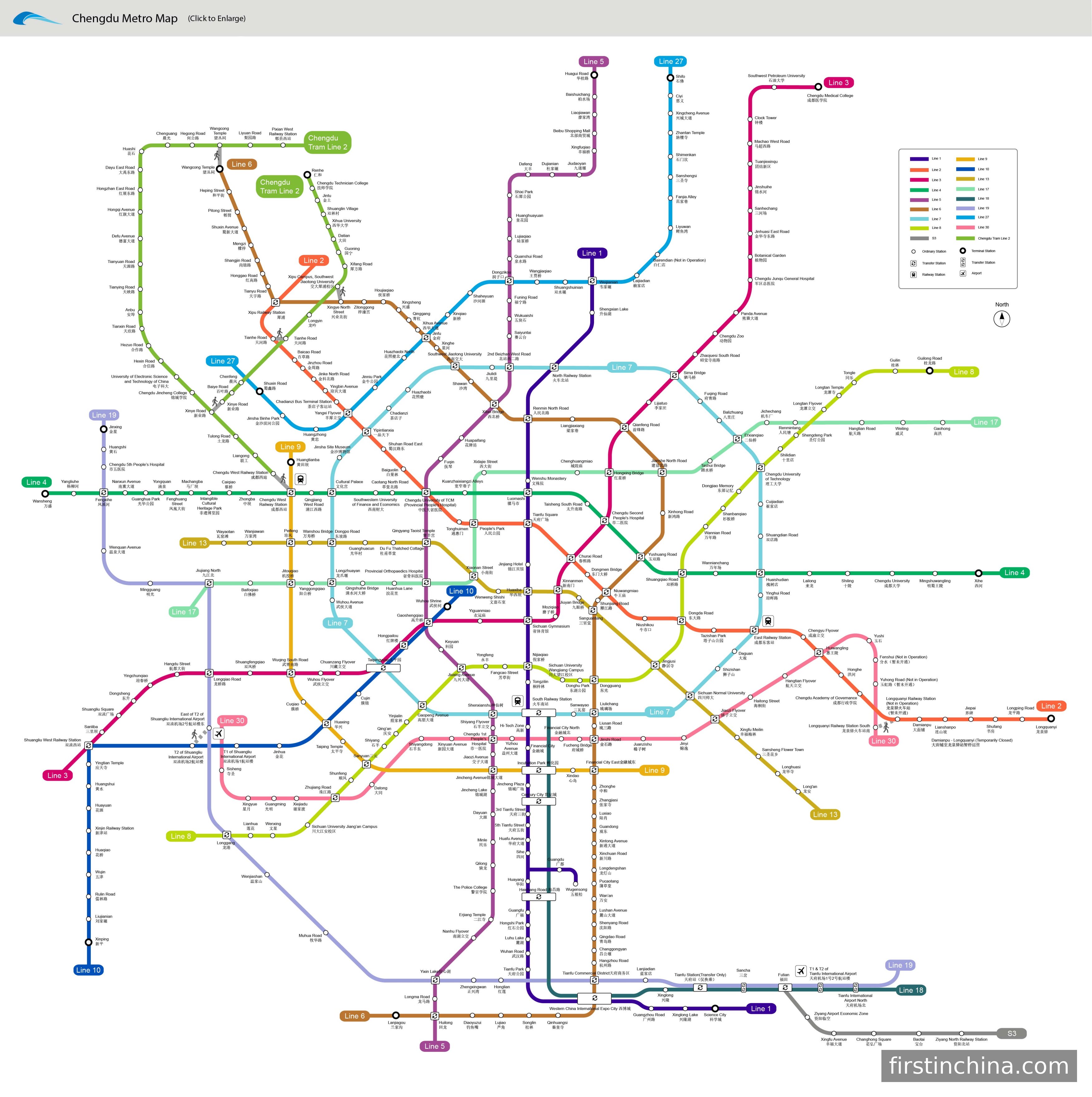
Chengdu Metro has grown into one of the world’s largest networks, with more than a dozen lines, but a first-timer needs only a handful. Signs and announcements are in Chinese and English, and the line number is shown on every platform, so you can navigate by number alone. Trains generally run from about 06:00 to about 23:00–23:30, depending on the line — check the last-train time on the station display before a late evening out.
| Line | What it does for a first-timer | Key stations |
|---|---|---|
| Line 1 (dark blue) | The north–south spine through the centre | North Railway Station → Wenshu Monastery → Luomashi → Tianfu Square (change to Line 2) → Jinjiang Hotel → South Railway Station (change to Lines 18 and 7) |
| Line 2 (orange) | The east–west line through the shopping heart | Chengdu East Railway Station → Chunxi Road → Tianfu Square (change to Line 1) → People’s Park → Chengdu University of Traditional Chinese Medicine |
| Line 3 (magenta) | The panda base and the old north | Panda Avenue (for the Giant Panda Breeding Research Base, then a short bus or taxi) → Chengdu Zoo → Wenshu Monastery area → Chunxi Road area → Taipingyuan (change to Line 10 for Shuangliu Airport) |
| Line 4 (green) | The alleys and the west | Kuanzhai Alley (Wide and Narrow Alleys) → Caotang (Du Fu Thatched Cottage area) → Chengdu University of Traditional Chinese Medicine |
| Line 7 (light blue, loop) | The ring line that links the radial lines | Chengdu East Railway Station, South Railway Station, North Railway Station and Taipingyuan all sit on or connect to the loop — useful when a direct line does not exist |
| Line 10 (dark blue) | Shuangliu Airport line | Taipingyuan (change to Lines 3 and 7) → Shuangliu International Airport Terminal 1 → Terminal 2 |
| Line 18 (dark teal, express) | Tianfu Airport express | South Railway Station (change to Lines 1 and 7) → Tianfu Airport Terminals 1 and 2 (Tianfu Airport North on some maps — follow the airport signs, not just the station name) |
| Line 19 (light purple, express) | The airport-to-airport and west line | Shuangliu Airport area → Tianfu Airport area, and on to Chengdu East via the shared corridor — check the direction display, as not every Line 19 train serves every airport stop |
How to ride: buy a single-journey token from the ticket machine (choose English on the screen, pick your destination, pay by cash or mobile payment), or scan a QR code — see Paying with Alipay or WeChat below. Put your bags through the security scanner at the entrance, tap or insert your token at the gate, and keep the token: you need it to exit. On the platform, follow the direction shown by the terminal station name, not just the line number — Line 1, for example, runs both north to Weijianian and south to Science City, with a branch to Wugensong.
Getting to and from the railway stations
Chengdu East Railway Station (Chengdudong) is the main high-speed station, on metro Lines 2 and 7, and handles most long-distance trains to Beijing, Shanghai, Xi’an, Chongqing and Guangzhou. Chengdu South Railway Station (Chengdunan), on Lines 1, 7 and 18, serves high-speed trains to Chongqing, Guiyang and Kunming and is the interchange for Tianfu Airport on Line 18. Chengdu Station (also called Chengdu North or North Railway Station by locals and on some metro signs), on Lines 1 and 7, handles long-distance and intercity services including Chongqing and Dujiangyan. As in every Chinese city, go to the station name printed on your ticket — Chengdu East, Chengdu South and Chengdu Station are different stations, and the local habit of calling Chengdu Station “North Station” is exactly the trap to avoid.
Bus: cheap, everywhere, mostly Chinese
Chengdu’s bus network reaches every neighbourhood, including places the metro does not, and most rides cost about ¥2, flat fare, paid when you board by transport card, QR code, or exact-change cash (drivers do not give change). The catch is the same as in every Chinese city: stop names and route maps are mostly in Chinese, and buses do not announce stops in English as reliably as the metro. The practical way to use buses is: plan the route in a map app (Amap/Gaode or Baidu Maps) before you board, save a screenshot of the stop names, and count stops. Use buses for short, simple trips — one bus, no change — and use the metro or DiDi for anything complicated. One useful exception: the city sightseeing bus routes around Wuhou Shrine, Jinli and Kuanzhai Alley are designed for visitors and are easier to follow than a normal city bus. Night buses run on some routes, but far less frequently; check the app on the day rather than assuming a night service.
Taxi: how to use one without Chinese
Chengdu taxis are easy to hail on main streets outside rush hour and rain, when they thin out quickly. The starting fare is about ¥8–9 for the first 2 km, then about ¥1.9 per kilometre, rising to about ¥2.85 per kilometre beyond 10 km to compensate for the empty return; at night the starting fare is about ¥1 higher and the per-kilometre fare about ¥2.2 — sources differ slightly, so treat these as ranges and read the meter. Three rules keep taxi rides painless: (1) always insist on the meter — if the driver refuses or quotes a flat price, get out and take the next taxi; (2) show the destination in Chinese characters from your hotel confirmation or a map app, because most drivers do not speak English; (3) keep the receipt from the meter printout, which has the taxi’s number if you leave something behind. Pay by cash or by scanning the QR code shown in the taxi with Alipay or WeChat Pay. At railway stations and airports, use the official taxi queue, not drivers who approach you inside the terminal. One Chengdu-specific warning: in rain or at peak dinner time, taxis are scarce and DiDi surge pricing rises — the metro is the reliable fallback, not a taxi queue.
DiDi: the easiest option for most first-timers
DiDi is China’s main ride-hailing app, with an English interface, foreign phone registration and international card payment. You type the destination in English, the app shows the price before you confirm, and the driver follows the app’s navigation — no Chinese conversation is needed. For the full step-by-step setup, car types and payment options, see our How to Use DiDi in China; the short version for Chengdu is: set your pickup point precisely (hotel name in English usually works, but the map pin matters more than the name), choose the car type, and if the driver calls, do not panic — they are usually confirming the pickup point, and you can reply with a short message in the app or ask your hotel to speak to them. DiDi is also the best fallback when the metro has stopped, when it is raining, or when you have heavy luggage from either airport.
Paying with Alipay or WeChat: how to ride by QR code
Foreign visitors can ride Chengdu’s metro and buses without a physical card, by using a transport QR code inside Alipay or WeChat Pay. Set this up before your first ride, while you have Wi-Fi, because it needs a one-time activation.
Alipay: open Alipay → Transport → select Chengdu (the city card is usually called Tianfutong, Chengdu’s transport card) → activate the metro/bus QR code and agree to the terms. At the metro gate, open the code and hold it over the scanner; do the same when you exit. On a bus, scan the code on the reader near the driver when you board. WeChat Pay: open WeChat → Services (or Me → Services) → Transport → select Chengdu and activate the local transport code, then use it the same way. The Tianfutong app itself also offers a QR code, but Alipay or WeChat is simpler for most foreign visitors because payment is already set up there. Full setup guides, including what to do if your foreign card is rejected, are in our Alipay guide and WeChat Pay guide.
Alternatives, and limits to know: single-journey tokens from metro ticket machines (English available) work for any one trip and are the simplest fallback if a QR code fails. A physical Tianfutong transport card, sold at metro stations and convenience stores for a small deposit plus credit (often about ¥25 for the card itself — check on the day), works on metro and bus and is worth it if you are staying several days. Two warnings: first, a transport QR code is city-specific — a code activated for another city will not work in Chengdu, so activate Chengdu’s code specifically. Second, QR-code availability for foreign cards can change — if activation fails, fall back to single-journey tokens or a physical card rather than assuming it will work at the gate, and check on the day.
Practical tips
- Stay near Line 1 or Line 2. A hotel near Tianfu Square, Chunxi Road or Taikoo Li puts the food streets, the alleys, the panda base route and both airport lines within one or two metro rides.
- Carry the Chinese name of your hotel. Save it as a screenshot, not just in an app — taxi drivers, bus conductors and hotel staff all read Chinese characters faster than pinyin.
- Security checks are normal. Bags go through an X-ray scanner at every metro entrance. Liquids, lighters and large tools may be confiscated — check the station signs if you are carrying anything unusual.
- Rain changes everything. Chengdu rain is frequent and light, but it still empties the taxi supply and slows buses. On a rainy evening, take the metro even if DiDi looks convenient.
- The panda base is a morning trip, not a metro stop. Take Line 3 to Panda Avenue, then a short bus or taxi to the base entrance, and go early — the pandas are most active in the morning and the base is crowded by midday.
- Walking the food streets is a transport choice too. Jinli, Kuanzhai Alley and Chunxi Road are walkable from each other in the centre, and walking is often faster than a one-stop metro ride plus security and interchange.
- Keep a backup plan for late nights. After the last metro, DiDi is the reliable option; street taxis thin out after midnight outside the centre, especially in rain.
Frequently asked questions
Which airport should I fly into, CTU or TFU?
Check your booking, not the city name. Shuangliu (CTU) is closer to the centre (Line 10, about 35–45 minutes); Tianfu (TFU) is about 50 km away (Line 18, about 50–60 minutes). Never assume — a pickup sent to the wrong airport is a costly mistake.
Can I use Alipay or WeChat to ride the Chengdu Metro?
Yes, in most cases — activate Chengdu’s transport QR code in Alipay (Transport) or WeChat Pay (Services → Transport) before your first ride, and scan it at the gates. If activation fails for your foreign card, use single-journey tokens from the ticket machines or buy a Tianfutong card at a metro station.
Which station do I use for high-speed trains?
Usually Chengdu East (Lines 2 and 7). Chengdu South (Lines 1, 7 and 18) serves Chongqing, Guiyang and Kunming routes, and Chengdu Station (Lines 1 and 7) serves other long-distance and intercity trains. Go to the station printed on your ticket.
Is the metro enough, or do I need buses?
The metro covers almost every first-timer sight, including both airports and Chengdu East. You need a bus only for the last stretch to a few places — notably the panda base from Panda Avenue station — and for neighbourhoods the metro does not reach.
Is DiDi better than a taxi in Chengdu?
For a first-timer, usually yes: the price is shown before you confirm, the destination is typed in English, and payment is in the app. Taxis are fine too if you insist on the meter and show the destination in Chinese characters — but in rain or at peak times, the metro beats both.
Last updated: October 2026. Metro lines, fares and last-train times change — check the station display, the official Chengdu Metro map, or a map app on the day before you travel. For the city’s food, see our Chengdu Food Guide, and for getting around Chinese cities in general, see Getting Around China Cities.