
- Guangzhou transport at a glance
- Metro: the lines that matter most
- Getting from Baiyun Airport (CAN) into the city
- Getting from the high-speed stations into the city
- Bus: when the metro does not go there
- Taxi: metered, and how to avoid the traps
- DiDi: door-to-door, with one link for the full tutorial
- Paying: how to use Alipay or WeChat Pay to ride metro and bus
- Practical tips for getting around Guangzhou
- Frequently asked questions
Short answer: In Guangzhou, take the metro for almost everything. It is signed in Chinese and English, covers the airport, the main high-speed station and every first-timer sight, and costs only a few yuan per ride. Use a bus for short hops the metro does not reach, a metered taxi or DiDi late at night or with luggage, and pay for metro and bus with a QR code in Alipay or WeChat Pay — no separate ticket app is needed for most trips. This guide covers each option in order, with the exact lines, stations and traps to avoid. For the city itself, see the Guangzhou for First Timers guide.
Guangzhou transport at a glance
| Mode | Best for | First-timer note |
|---|---|---|
| Metro | Almost every trip | Lines 1, 2, 3, 5, 6, 8 and the Line 11 loop; English signs and announcements in Mandarin, Cantonese and English |
| Bus | Short hops and places off the metro | Pay with the same Alipay/WeChat transport QR code, or a Yangchengtong card; route numbers are in Chinese and English on most stops |
| Taxi | Airport arrivals with luggage, late nights, groups | Always insist on the meter; show the address in Chinese characters on your phone |
| DiDi | Door-to-door trips, rain, late nights | Set it up before you need it — see the DiDi guide for the full tutorial |
Metro: the lines that matter most
Guangzhou Metro has 19 lines and close to 400 stations, but a first-timer needs only a handful. Most lines run roughly 06:00 to about 23:00, with first and last trains varying by line and direction — check the station display on the day, especially for an early airport trip or a late return. Fares are distance-based and start at about ¥2 for a short ride, rising by a few yuan for longer trips; check the fare shown on the machine or in the app before you travel, as it is an example, not a fixed price for every journey.
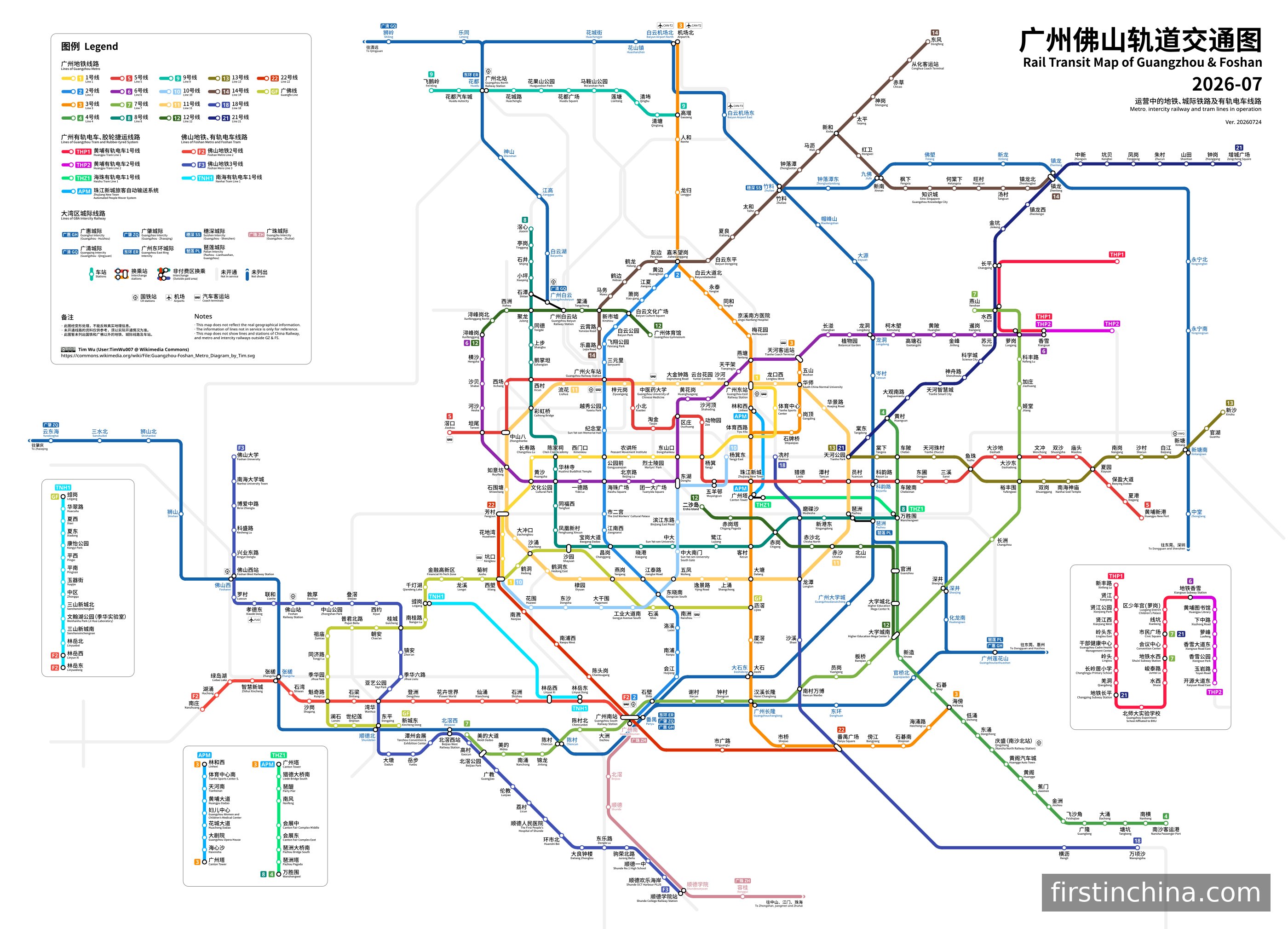
| Line | Use it for | Key stations |
|---|---|---|
| Line 1 | Old city, shopping, east-west centre | Xilang, Huangsha, Chen Clan Academy, Gongyuanqian, Tiyu Xilu, Guangzhou East Railway Station |
| Line 2 | High-speed station to old centre | Guangzhou South Railway Station, Changgang, Gongyuanqian, Sun Yat-sen Memorial Hall, Yuexiu Park, Guangzhou Railway Station, Jiahewanggang |
| Line 3 (including the northern extension) | Airport, Canton Tower, Zhujiang New Town | Airport North (Terminal 2), Airport South (Terminal 1, currently closed — see below), Jiahewanggang, Guangzhou East Railway Station, Tiyu Xilu, Canton Tower, Zhujiang New Town |
| Line 5 | Zoo, Zhujiang New Town, east-west | Jiaokou, Guangzhou Railway Station, Zhujiang New Town, Huangpu New Port |
| Line 6 | Old city east-west, Beijing Road area | Xunfenggang, Huangsha, Haizhu Square, Beijing Lu, Dongshankou, Tianhe Coach Terminal |
| Line 8 | Canton Fair, Pazhou, riverfront | Jiaoxin, Chen Clan Academy area connections, Pazhou, Wanshengwei |
| Line 11 | The loop around the centre | The city’s first loop line, opened December 2024, connecting Guangzhou East Railway Station, Guangzhou Railway Station and other central interchanges — useful when a direct line is crowded |
| APM | Canton Tower to Zhujiang New Town | Canton Tower, Opera House, Zhujiang New Town — a short driverless people-mover, handy for the tower and the new CBD |
How to ride: Follow the English signs for the line colour and number, then the direction (the terminus station name). At an interchange, follow the transfer signs — large stations such as Tiyu Xilu, Gongyuanqian and Jiahewanggang can take several minutes to cross, so allow extra time. Keep your bag ready for the security check at the station entrance, which is routine in China. If you get on the wrong direction, get off at the next station and cross to the other platform; you do not need a new ticket or QR scan for that.
Getting from Baiyun Airport (CAN) into the city
Check your terminal first, because the terminal layout changed recently. Terminal 1 closed to passengers on 7 May 2026 for renovation, and passenger flights now use Terminal 2 or Terminal 3 only. Any older guide that sends you to Terminal 1 is out of date.
From Terminal 2, take Metro Line 3. Airport North station serves Terminal 2. Ride south towards Tiyu Xilu for the Tianhe sports centre area and Zhujiang New Town — allow about 45–50 minutes to Tiyu Xilu or Zhujiang New Town. To reach the old centre, change at Jiahewanggang for Line 2 towards Guangzhou South, or ride to Tiyu Xilu and change there. From Terminal 3, there is no direct metro line as of the latest reports. Terminal 3’s rail station is Baiyun Airport East on the intercity railway, and free shuttle buses run between Terminals 2 and 3 — from Terminal 3, shuttle to Terminal 2 and take Line 3, or take the intercity train and check its stops on the day. If you land late, or the metro has stopped, use the airport bus or a taxi/DiDi instead, and allow extra time in rain or rush hour.
Getting from the high-speed stations into the city
Guangzhou South Railway Station is the main high-speed station and is a long way south of the centre. From the airport, take Line 3 to Jiahewanggang, change to Line 2, and ride to the Guangzhou South terminus — allow about 75–90 minutes in total, including the change. From central Guangzhou to Guangzhou South, Line 2 runs directly there; allow about an hour or more depending on your starting station, and arrive early, as the station is large and busy. Guangzhou East Railway Station (Lines 1 and 3) is much closer to the centre and serves other routes, and Guangzhou North Railway Station (Line 9) is much closer to the airport — Guangzhou South, Guangzhou East and Guangzhou North are three different stations, so always travel to the station name printed on your ticket.
Bus: when the metro does not go there
Guangzhou’s buses fill the gaps: neighbourhood streets, the university town, and some riverfront and suburban sights. Board at the front, get off at the back, and watch the stop display — most city buses announce stops in Chinese and English, but not all. The same Alipay or WeChat transport QR code that works on the metro usually works on city buses (see the payment section below); otherwise buy a Yangchengtong stored-value card at a metro station or convenience store, or pay the exact cash fare in the fare box, as drivers generally do not give change. If a bus route number looks unfamiliar, check it in Amap (Gaode) or the metro app before boarding, rather than guessing from a paper map.
Taxi: metered, and how to avoid the traps
Taxis are plentiful in the centre, at the airport and at railway stations, and they are the best option with heavy luggage, in heavy rain, or after the metro stops. Always insist on the meter — if a driver quotes a fixed price at an airport or station, walk away and take the next taxi in the official queue. Show the destination in Chinese characters on your phone, and save your hotel’s Chinese address before you go out, as many drivers do not speak English. Keep the printed receipt: it has the taxi number, which you need if you leave something behind. Fares start at a low flagfall and rise by distance and waiting time; a cross-city trip, for example from the airport to the centre, will cost several times a metro ride, so use a taxi for convenience, not to save money.
DiDi: door-to-door, with one link for the full tutorial
DiDi is usually the easiest door-to-door option in Guangzhou, especially at night, in rain, or from a hotel to a station. It works in English inside the app, shows the price before you confirm, and lets you pay with Alipay or WeChat Pay. The full step-by-step — setting up the app, choosing Express, Premier or a larger car, entering a Chinese address, and what to do if a driver cancels — is in the DiDi guide, so this article does not repeat it. In short: set DiDi up before your first trip, not at the airport kerb, and always check the car plate and colour before getting in.
Paying: how to use Alipay or WeChat Pay to ride metro and bus
You do not need a separate metro app for most trips. The method that works for most foreign visitors is a transport QR code inside the payment app you already use:
Alipay: Open Alipay, tap Transport, select Guangzhou as the city, and activate the metro/bus ride code. Then hold the QR code up to the scanner at the metro gate (on entry and again on exit, where required) or to the bus scanner when you board. If you have not set up Alipay yet, follow the Alipay setup guide first — you need a linked foreign card or a verified account before the transport code will work.
WeChat Pay: Open WeChat, go to Me > Services > Transport (the exact menu name varies by app version and region), select Guangzhou, and activate the ride code. Use it the same way: scan at the gate and on the bus. If you have not set up WeChat Pay yet, follow the WeChat Pay setup guide first.
Alternatives, and their limits: Single-journey tokens are sold at ticket machines in every metro station — choose the English interface, select your destination station, and pay by cash, card or QR code. A Yangchengtong stored-value card, sold at stations and convenience stores, works on metro and bus and saves queuing for tokens, but you must top it up and it is not refundable in full at every outlet. Two things to check on the day: first, make sure the transport code is set to Guangzhou, not another city you visited before, as a code for the wrong city will not open the gate; second, some bus routes and the APM may accept the code differently, so carry a small amount of cash or a topped-up card as a backup. For the general rules on getting around Chinese cities, see Getting Around China Cities.
Practical tips for getting around Guangzhou
Save every destination in Chinese characters on your phone — station names, hotel names and sight names — and show them to drivers and station staff when words fail. Avoid the morning and evening rush (roughly 07:30–09:00 and 17:30–19:00) if you can, especially on Lines 1, 2 and 3, as trains get very crowded and large interchange stations take longer to cross. Keep your phone charged: your metro QR code, your DiDi booking and your map all live on it, so carry a power bank. If you are travelling with luggage, use the lifts at metro stations and the larger gates, and avoid the busiest central stations at rush hour. Finally, check the last train before a late dinner or a night river cruise — a taxi or DiDi home is cheap insurance against a missed last train.
Frequently asked questions
Is the Guangzhou Metro easy for a first-timer who does not read Chinese?
Yes, for the main lines. Signs, station names and announcements are in Chinese and English, and the line numbers and colours are the same in every app and on every map. Save your destination in Chinese characters as a backup, and follow the terminus name for the direction, not just the line colour.
How do I get from Baiyun Airport to the city centre?
From Terminal 2, take Line 3 south to Tiyu Xilu or Zhujiang New Town, about 45–50 minutes. From Terminal 3, shuttle to Terminal 2 and take Line 3, or take the intercity train from Baiyun Airport East and check its stops on the day. Terminal 1 is closed to passengers since 7 May 2026.
Can I pay for the metro with Alipay or WeChat Pay?
Yes, with a transport QR code: Alipay > Transport > Guangzhou, or WeChat > Me > Services > Transport > Guangzhou. Scan at the gate and on the bus. Make sure the code is set to Guangzhou, and carry cash or a Yangchengtong card as a backup.
Which station do I use for high-speed trains?
Most long-distance high-speed trains use Guangzhou South Railway Station (Line 2). Guangzhou East (Lines 1 and 3) and Guangzhou North (Line 9) serve other routes. Always go to the station name printed on your ticket — they are far apart.
Is DiDi or a taxi better than the metro in Guangzhou?
For most daytime trips, the metro is faster and cheaper, especially to the airport and the high-speed station. Use DiDi or a metered taxi late at night, in heavy rain, with luggage, or for door-to-door trips the metro does not serve well. See the DiDi guide for setup.