
- Chongqing transport at a glance
- Metro: Chongqing Rail Transit, including the monorail lines
- From the airport and railway stations into the city
- Bus: useful for short hops, hard without Chinese
- Taxi: meter, Chinese address, hills
- DiDi: set it up before you need it
- Paying for metro and bus with Alipay or WeChat
- Practical tips for getting around Chongqing
- Frequently asked questions
Short answer: use the metro for most trips in Chongqing, DiDi for hills and late nights, and buses only for short, specific hops. Chongqing is a mountain city built on peninsulas and river crossings, so a route that looks short on a map can involve steep steps, a long interchange walk, or a river bridge. The metro — officially Chongqing Rail Transit (CRT) — reaches the airport, the main railway stations, Jiefangbei, Hongya Cave, Ciqikou and Guanyinqiao. Read the direction name on the platform, not just the line number: several lines cross rivers and peninsulas, and going the wrong way can cost you 30 minutes or more.
If you are planning the sights themselves, start with our Chongqing for First Timers guide, then use this page for how to move between them. For moving between Chinese cities in general, see How to Get Around Chinese Cities.
Chongqing transport at a glance
| Mode | Best for | Cost, as a range | First-timer note |
|---|---|---|---|
| Metro (CRT) | Airport, railway stations, Jiefangbei, Ciqikou, Guanyinqiao | Roughly ¥2–10 per ride, by distance | English and pinyin station names; check the last train on the day |
| Bus | Short hops, places the metro does not reach | Roughly ¥1–2 per ride in town | Routes are in Chinese; save your stop in Chinese characters |
| Taxi | Hills, rain, luggage, late nights | Metered; airport to centre roughly ¥50–100 in normal traffic | Show the address in Chinese; ask for the meter |
| DiDi | Door-to-door trips, hills, groups | Shown in the app before you confirm | Set it up before you need it — see the DiDi section below |
| Yangtze river trips | Night views, not daily commuting | Varies by operator and route | Book through your hotel or the official pier; check departure times on the day |
Metro: Chongqing Rail Transit, including the monorail lines
Chongqing’s metro is one of the largest in the world by length, with more than 300 stations. Two of its most famous lines are not conventional subways at all: Lines 2 and 3 are straddle-beam monorails, running on elevated tracks above streets and, in places, through buildings. Line 2’s Liziba station, where the train passes through a residential block, is a sight in itself — but ride it as transport first and as a photo stop second, and do not block the platform for a photo.
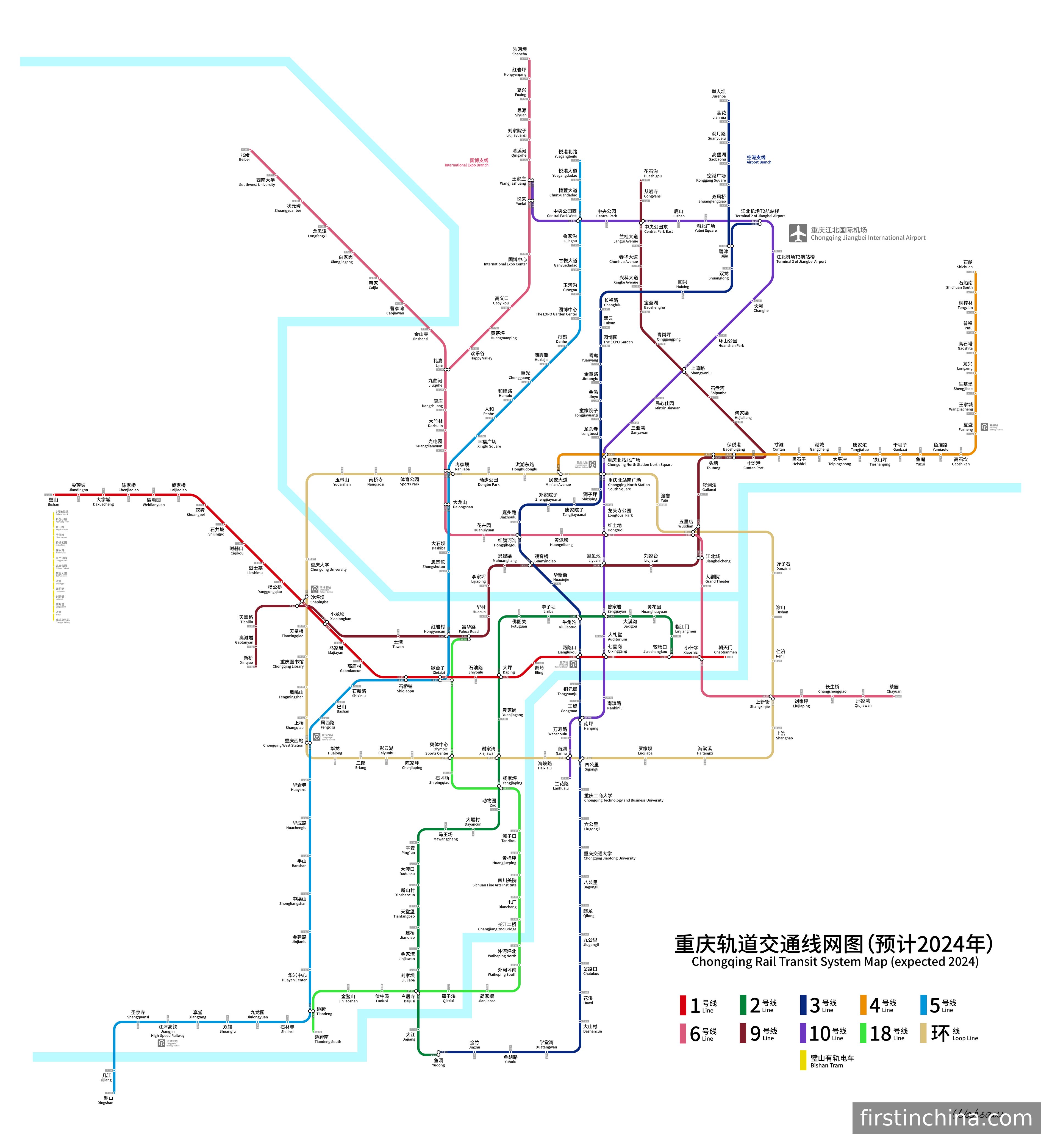

The lines first-timers actually use
| Line | Type | Route, in brief | Why first-timers use it |
|---|---|---|---|
| Line 1 | Subway | Chaotianmen ↔ Bishan | Xiaoshizi (Hongya Cave), Jiaochangkou, Shapingba, Ciqikou |
| Line 2 | Monorail | Jiaochangkou ↔ Yudong | Liziba (through-the-building station), Linjiangmen for Jiefangbei, Chongqing Zoo |
| Line 3 | Monorail | Yudong ↔ Jiangbei Airport Terminal 2 | Guanyinqiao, Lianglukou interchange, airport Terminal 2 only |
| Line 6 | Subway | Chayuan ↔ Beibei | Xiaoshizi, Grand Theatre, Hongtudi — the deepest interchange |
| Line 9 | Subway | Gaotanyan ↔ Huashigou | Guanyinqiao via Liyuchi, Shapingba interchange |
| Line 10 | Subway | Lanhualu ↔ Wangjiazhuang | Jiangbei Airport Terminals 2 and 3, Chongqing North Station, Hongtudi |
| Loop Line | Subway (circle) | Chongqing West ↔ Shapingba ↔ Chongqing West | Chongqing West Station, Shapingba Station, Chongqing Library |
Other lines (4, 5, 18 and suburban lines) mainly serve outer districts. You do not need to learn them for a first trip — learn the interchange stations instead: Xiaoshizi (Lines 1 and 6), Jiaochangkou (Lines 1 and 2), Lianglukou (Lines 1 and 3), Hongtudi (Lines 6 and 10) and Niujiaotuo (Lines 2 and 3).
Metro hours and fares
Most lines run roughly from 06:00–06:30 to about 22:30–23:00, with first and last trains varying by line and direction — the station display on the day is the only reliable source, especially for Line 3 and Line 10 airport services. Fares are distance-based, roughly ¥2–10 for most first-timer rides; the airport-to-Jiefangbei ride is about ¥6–7. Buy a single-journey ticket from a machine, use a transport card, or use a phone QR code (see the payment section below). Keep your ticket or phone ready at the exit gate: Chongqing, like other Chinese metros, charges by distance and you tap out as well as in.
Hongtudi: allow extra time for the deepest interchange
Hongtudi station, where Line 10 meets Line 6, is about 94 metres underground — one of the deepest metro stations in the world. The interchange involves long escalators and a long walk, so allow an extra 10 minutes or more there, especially with luggage. If you are travelling light and in a hurry, a different interchange (for example Line 3 to Line 2 at Niujiaotuo for Jiefangbei) is sometimes faster, even if it looks longer on the map.
From the airport and railway stations into the city
Chongqing Jiangbei International Airport (CKG)
Chongqing has one main airport, Jiangbei International Airport (CKG), about 20–25 km north-east of the centre. Its passenger terminals are T2 and T3 (T1 is older and no longer the main passenger terminal — follow your boarding pass, not an old guide). Both T2 and T3 have metro stations:
- From T3 or T2 on Line 10: take Line 10 to Hongtudi, change to Line 6, and get off at Xiaoshizi for Jiefangbei and Hongya Cave. Allow about 45–60 minutes in total, including the change and the walk from Xiaoshizi to your hotel. This is the simplest airport route for most first-timers.
- From T2 on Line 3 (monorail): take Line 3 directly to Guanyinqiao if that is where you are staying, or to Niujiaotuo and change to Line 2 for Linjiangmen (Jiefangbei). Line 3 serves Terminal 2 only — if you land at T3, use Line 10, not Line 3.
- Airport bus: lines include K01 to Jiefangbei, K06 to Chongqing West Station and K07 to Shapingba Station, but routes and numbers change — check the bus board at the airport on the day. A taxi or DiDi to the centre takes roughly 30–40 minutes in normal traffic and roughly ¥50–100, more in rush hour or rain.
High-speed railway stations
Chongqing North is usually the most convenient station for the centre — it is on Line 10, with a North Square and a South Square that are not the same entrance, so follow the signs for your train’s square. Chongqing West (Loop Line and Line 5) and Shapingba (Lines 1, 9 and the Loop Line) also have trains, and the newer Chongqing East (Line 6 branch) is also in service. As in every Chinese city, go by the exact station name on your ticket: Chongqing North, Chongqing West, Shapingba and Chongqing East are far apart, and a taxi sent to the wrong one can cost you your train.
Bus: useful for short hops, hard without Chinese
Chongqing’s buses cover places the metro does not, and they are cheap (roughly ¥1–2 in town). The catch for first-timers is that bus stop names, route boards and on-board announcements are mostly in Chinese, and a bus can sit in the same traffic you are trying to avoid. Use buses for a short, specific hop you have already mapped — for example, a hotel to a pier — and save the stop name and the bus number in Chinese characters on your phone. If you are not sure which direction a bus runs, ask your hotel to write it down, or take DiDi instead: a wrong-direction bus ride in a mountain city is a long way back.
Taxi: meter, Chinese address, hills
Flag a taxi on the street, or take one from a hotel or station rank. Always ask for the meter (打表, dǎ biǎo) and show the destination in Chinese characters — most drivers do not speak English, and a hotel name in English alone is often not enough. Taxis are the right choice in heavy rain, with heavy luggage, on steep hills, or late at night when the metro has stopped. Fares are metered by distance and time in traffic; a short centre ride is a few tens of yuan, and the airport-to-centre ride is roughly ¥50–100 in normal traffic. Keep small notes or pay by phone QR code (see below) — drivers may not have change for large notes late at night.
DiDi: set it up before you need it
DiDi is the ride-hailing app most visitors use in Chongqing, and it solves the two taxi problems at once: you enter the destination in the app, and the price is shown before you confirm. It is especially useful here because Chongqing’s hills, one-way streets and river crossings make walking directions unreliable. This section is only a summary — for the full step-by-step setup, booking and payment tutorial, see our How to Use DiDi in China guide. In short: install DiDi (or use it inside Alipay or WeChat), add a payment method before your first ride, pin the pickup point carefully — a pin on the wrong side of a river or an elevated road can send your driver to the wrong level — and message the driver through the app’s translation feature if needed. DiDi is not a substitute for the metro on the airport run in rush hour: a metro ride is often faster than a car stuck on a bridge.
Paying for metro and bus with Alipay or WeChat
You do not need a local bank card to ride Chongqing’s metro or most buses. The two routes visitors use are:
Option 1: a transport QR code in Alipay or WeChat (the easiest for most visitors)
- Alipay: open Alipay, go to Transport, select Chongqing, and get the Chongqing transport QR code. At the metro gate, scan the code to enter and scan again to exit; on a bus, scan once when you board. The fare is charged to your linked card or balance.
- WeChat: open WeChat, go to Services (or Me) → Transport, select Chongqing, and get the transport QR code the same way. Some visitors find WeChat’s setup stricter about foreign cards — if it will not activate, use Alipay instead, or fall back to single-journey tickets.
For the full setup steps, including linking a foreign card, see How to Set Up Alipay for Foreigners and How to Set Up WeChat Pay for Foreigners. Set the transport code up before your first metro ride, ideally at the hotel on Wi-Fi — station Wi-Fi and mobile signal can be patchy in deep stations like Hongtudi, and you do not want to be setting up an app in a ticket queue.
Option 2: single-journey tickets and transport cards
Single-journey tickets are sold from machines in every metro station, with English on the screen — choose your destination station, pay cash or by phone QR, and keep the ticket for the exit gate. A rechargeable transport card, sold at station service counters, is worth it if you will ride more than a few times a day, but a phone QR code is simpler for most first-timers and avoids a card deposit. Note that transport QR codes are city-specific: a Chongqing code does not work in another city, and you will need to activate that city’s code when you move on. If a QR code will not scan at a gate, step aside, switch to a single-journey ticket, and sort the app out later — do not block the gate queue.
Practical tips for getting around Chongqing
- Direction names matter more than line numbers. At an interchange, check the direction (the terminus station name) as well as the line. Chongqing’s lines loop, branch and cross rivers, and the same line can take you to opposite sides of the city.
- Budget for steps and slopes. Even a “metro” trip often ends with a steep walk, an escalator bank or a flight of steps to a peninsula hotel. Comfortable shoes matter more here than in flat cities, and a DiDi to the hotel door is worth it after a long day.
- River crossings are bottlenecks. Bridges and tunnels across the Yangtze and Jialing rivers jam in rush hour. If you must cross a river by road, allow double the normal time, or take the metro across instead.
- Save everything in Chinese. Hotel name and address, station names, pier names and bus stops — all in Chinese characters, with a screenshot in case you lose signal. Show the phone, do not try to pronounce a station name you have only seen in pinyin.
- Late nights mean DiDi or taxi. The metro stops around 22:30–23:00 depending on the line. If you are out for a night river cruise or a late hotpot, plan the ride home before you go out, and confirm the pickup point — a pier exit and a street exit can be on different levels.
Frequently asked questions
Is the Chongqing metro easy for a first-timer who does not speak Chinese?
Yes, for the main lines: station names are in Chinese and pinyin, line numbers and colours are consistent, and the key interchanges are signed in English. The hard parts are the depth of Hongtudi, the direction names, and the hills after you exit — all covered above.
Which metro line goes to the airport?
Line 10 serves both Jiangbei Airport Terminals 2 and 3. Line 3 serves Terminal 2 only. From either terminal, Line 10 to Hongtudi, then Line 6 to Xiaoshizi, is the simplest route to Jiefangbei and Hongya Cave.
Can I pay for the metro with Alipay?
Yes — activate the Chongqing transport QR code in Alipay under Transport before your first ride, and scan it at the entry and exit gates. WeChat’s transport code works the same way, but some foreign cards activate more easily in Alipay. Single-journey tickets from station machines are the fallback.
Is DiDi better than a taxi in Chongqing?
For most visitors, yes: you enter the destination in the app, see the price before confirming, and avoid the language problem. Use the metro for the airport run and river crossings in rush hour, and DiDi for hills, rain and late nights. Full setup is in our DiDi guide.
Do I need to worry about which railway station my train uses?
Yes — Chongqing North, Chongqing West, Shapingba and Chongqing East are different stations in different parts of the city. Chongqing North (Line 10) is the most convenient default, but always travel to the exact station name on your ticket.