
- Hangzhou transport at a glance
- Metro: the backbone of getting around Hangzhou
- Bus: cheap, useful for short hops
- Taxi: metered, and the Chinese address is the key
- DiDi: the easiest door-to-door option (summary)
- Paying: Alipay and WeChat QR codes for metro and bus
- Airport and railway stations: getting into the city
- When to use what: a first-timer’s decision guide
- Practical tips and first-timer mistakes
- Frequently asked questions
Short answer: use the metro first, DiDi second, and buses for the last short hop. Hangzhou’s metro reaches Xiaoshan Airport, Hangzhou East station, West Lake, Wulin Square and the main shopping and tea areas, and it is signed in English and Chinese. You do not need a car, and you do not need to understand Chinese to ride it — you need a working Alipay or WeChat transport code (explained below), the English station name of your destination, and a check of the last train if you are out late. This guide covers the metro, buses, taxis and DiDi in Hangzhou, how to pay for each, and how to get from the airport and the railway stations into the city. For the sights themselves, see our Hangzhou for First Timers guide.
Hangzhou transport at a glance
| Way to travel | Best for | First-timer note |
|---|---|---|
| Metro | Airport, railway stations, West Lake, Wulin Square, most sights | Fastest and easiest. Lines 1, 7 and 19 serve the airport; Line 19 is the express. |
| Bus | Short hops, lake-area streets, places just beyond a metro station | Cheap, but slower in traffic and harder to follow without a map app. |
| Taxi | Late nights, heavy luggage, groups, rain | Metered. Have the address in Chinese characters saved on your phone. |
| DiDi | Door-to-door trips when you do not want to explain an address | Best for non-Chinese speakers. See our DiDi guide for the full steps. |
| Walking / cycling | Around West Lake itself | The lake area is best on foot or by bike; the metro is better for crossing the city. |
Metro: the backbone of getting around Hangzhou
Hangzhou Metro opened in 2012 and now runs more than a dozen lines across the city, including Lines 1, 2, 3, 4, 5, 6, 7, 8, 9, 10, 16 and 19. You will use only a handful of them as a first-timer, and they are all signed in English and Chinese, with English announcements. Trains generally run from about 06:00 to about 22:30–23:00, depending on the line, with later trains on the airport express Line 19 — always check the last train on the station display on the day, especially after a late dinner or a late flight, because a missed last train means a taxi or DiDi instead. Fares are distance-based and start at about ¥2 for a short ride; a cross-city ride costs more, and the exact fare is shown when you buy a ticket or scan your code, so treat any single figure in a guide as an example, not a current price.
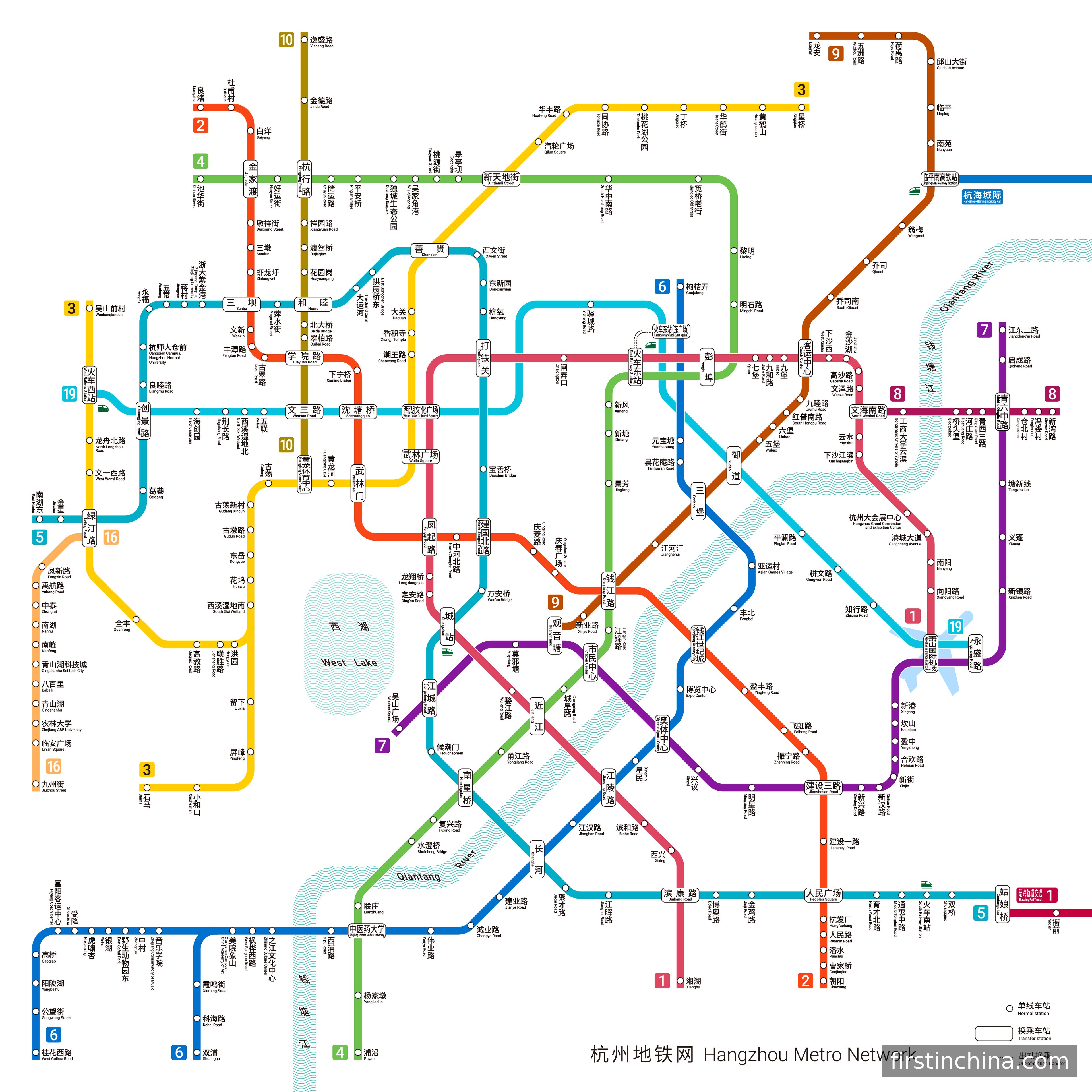
Lines first-timers actually use
| Line | Why it matters for you | Key stations |
|---|---|---|
| Line 1 | The old backbone: airport, Hangzhou East, West Lake area, old centre | Xiaoshan International Airport, East Railway Station, West Lake Cultural Square, Wulin Square, Fengqi Road, Longxiangqiao, Chengzhan |
| Line 19 | The express: airport, Hangzhou East and Hangzhou West in one fast line | West Railway Station, East Railway Station (East Square), Xiaoshan International Airport |
| Line 7 | Old town to the airport via the Qianjiang New City area | Wushan Square, Xiaoshan International Airport |
| Line 2 | North–south through the centre | Fengqi Road, Wulin Square area, Shentangqiao |
| Line 3 | West side, West Lake’s north edge, Hangzhou West station | West Railway Station, West Lake Cultural Square, Wulin Square |
| Line 4 | East–west arc via Hangzhou East and the Qianjiang area | East Railway Station, Pengbu, Citizen Center area |
| Line 5 | Cross-city trunk, including Chengzhan and Hangzhou South | Chengzhan, South Railway Station |
| Line 6 | South and west, including Hangzhou East | East Railway Station, Binjiang area |
How to ride, step by step: (1) Find your destination’s English station name before you enter the station — save it in Chinese characters too, in case you need to ask staff. (2) Enter with a transport code in Alipay or WeChat (see “Paying” below), a single-journey ticket from a machine, or a local transport card. (3) Follow the line colour and the direction name, which is the terminus station — for example, on Line 1 towards the airport, the direction is Xiaoshan International Airport. (4) At an interchange, follow the numbered line signs, not the exit signs; the largest stations, especially East Railway Station, involve a long walk between lines, so allow extra time. (5) When you exit, check the exit letter against your hotel or sight — the wrong exit at Wulin Square or West Lake Cultural Square can add a 10-minute walk.
Getting to the sights by metro
- West Lake: Line 1 to Longxiangqiao (south end of the lake, near the main lakeside walk) or Fengqi Road, or Line 1/3/19 to West Lake Cultural Square (north side). The lake itself is walked, not ridden — the metro gets you to its edge.
- Lingyin Temple and Feilai Feng: take the metro to the west side (Line 3 area) and then a bus or DiDi for the last stretch — the temple is in the hills, not directly on a metro station, so plan a short bus or taxi leg.
- Longjing tea villages: metro to the west side, then bus or DiDi into the hills. Do not expect a metro station in the tea fields.
- Hefang Street and Qinghefang (old streets): Line 1 to Ding’an Road, then walk. This is also walkable from the West Lake’s south end.
- Wulin Square and the main shopping streets: Line 1/2/3 around Wulin Square and Fengqi Road.
Bus: cheap, useful for short hops
Hangzhou’s buses fill the gaps the metro does not reach: the temple hills, the tea villages, lakeside roads, and neighbourhood streets. Most central city buses charge a flat low fare — typically about ¥2 for an ordinary city route, with longer or suburban routes costing more — and you pay with the same Alipay or WeChat transport code, a transport card, or cash in small bills where accepted; the fare is shown on the bus or in your map app, so check it on the day rather than relying on a single figure here. Buses are slower than the metro in traffic, and route numbers and stops are easier to follow in a map app (Amap or Baidu Maps, with your destination in Chinese) than on a printed timetable. Two practical rules: board at the front and scan or pay as you board, and press the stop button well before your stop, because drivers do not always stop unless asked. If a journey needs more than one bus change, the metro plus a short DiDi is usually faster and simpler for a first-timer.
Taxi: metered, and the Chinese address is the key
Hangzhou taxis are metered, widely available at the airport, railway stations and hotels, and useful late at night, in rain, or with heavy luggage. The single most important habit is to have your destination in Chinese characters on your phone — drivers rarely speak English, and a hotel name in English alone is often not enough. Ask the driver to use the meter (“打表”, dǎ biǎo) if it is not already running, and keep the receipt, which has the taxi number, in case you leave something behind. Fares are metered by distance and time, with a starting fare and per-kilometre rate that change over time, so do not rely on a quoted total from a guide; the meter is the price. At the airport and railway stations, use the official taxi queue, not drivers who approach you inside the terminal offering a fixed price — that fixed price is almost always higher than the meter. If you cannot explain the address, DiDi (below) is the easier option, because the destination is set in the app.
DiDi: the easiest door-to-door option (summary)
DiDi is China’s main ride-hailing app and the simplest way to get a car without speaking Chinese: you set the destination in the app, the price is shown before you confirm, and payment runs through Alipay or WeChat Pay. It is the best choice for the airport with luggage, for the temple and tea-village hills, and for any trip where the metro plus bus would need two changes. For the full step-by-step setup — downloading the app, linking a foreign card, choosing a car type, and what to do if the driver calls you — read our How to Use DiDi in China guide, which this section deliberately does not duplicate. One warning that belongs here: at Hangzhou East station and at the airport, DiDi pickup points are in signed areas that can be a few minutes’ walk from the arrivals hall, so read the pickup instructions in the app before you start walking.
Paying: Alipay and WeChat QR codes for metro and bus
This is the part to set up before you need it, ideally before you fly. Both Alipay and WeChat Pay can generate a transport QR code that you scan at metro gates and on buses, so you do not need to buy a ticket for every ride. The code is city-specific: a Hangzhou code does not work in another city, and you will need to activate the Hangzhou code separately when you arrive.
Alipay transport code
Open Alipay, go to Transport, select Hangzhou, and follow the prompts to activate the Hangzhou metro/bus code. You will need a payment method linked in Alipay — see our How to Set Up Alipay for Foreigners guide for that setup. Once activated, open the Transport code before you reach the gate, hold it to the scanner, and do the same to exit at metro stations (the exit scan is how the fare is calculated). If the code does not open, check that you have a data connection and that you selected Hangzhou, not another city — that city mismatch is the most common first-timer failure. If it still does not work, buy a single-journey ticket from a machine instead; machines usually offer an English option.
WeChat transport code
In WeChat, go to Me > Services > Transport (the exact menu wording varies by WeChat version), select Hangzhou, and activate the code following the in-app prompts. You will need WeChat Pay set up first — see our How to Set Up WeChat Pay for Foreigners guide. Use it the same way: scan to enter, scan to exit at metro gates, scan once when boarding a bus. The same city rule applies: a code activated for another city will not open Hangzhou gates.
Alternatives if QR codes fail
Single-journey tickets: buy from a machine at any metro station, choosing your destination station on the screen (English is usually available). Keep the ticket for the exit gate. Local transport card: buy and top up a card at a metro station service centre; it works on metro and buses and saves you opening an app at every gate, and any remaining balance rules vary, so ask at the counter before loading a large amount. Cash on buses: small bills only, and only where the bus accepts cash — do not rely on cash as your only option, because many first-timers are caught out by a bus that is QR-only in practice. If your phone battery is low, buy a ticket or use a card instead of depending on a QR code.
Airport and railway stations: getting into the city
From Xiaoshan International Airport (HGH)
Hangzhou Xiaoshan International Airport is south-east of the city. The metro station is in the airport transport centre (B1 level), served by Lines 1, 7 and 19. Line 19 is the fastest way into the city: it reaches Hangzhou East Railway Station in about 20–30 minutes and continues to West Lake Cultural Square, which is useful for the West Lake area. Line 1 also runs from the airport through Hangzhou East and on to Longxiangqiao and Chengzhan near the West Lake’s south end, but it stops more often, so allow about 45–60 minutes to the West Lake area on Line 1. Check the last train on the station display on the day — Line 19’s last trains leave earlier than many late arrivals expect, and an airport bus or DiDi is the fallback after that. Airport buses also run to the city centre; check the route board and fare at the airport, because routes and fares change. A DiDi or taxi from the airport to the West Lake area takes roughly 40–60 minutes in normal traffic and longer in rush hour — check the in-app price before confirming.
From the railway stations
Hangzhou East (Hangzhoudong) is the main high-speed station, served by metro Lines 1, 4, 6 and 19. It is large and busy: allow extra time to find your metro entrance, and check your train, platform and entrance in advance for departures. From Hangzhou East, Line 1 south reaches the West Lake area, and Line 19 reaches the airport and Hangzhou West. Hangzhou West (Hangzhouxi), on Lines 3 and 19, serves other routes and is useful for the western side of the city and Xixi Wetland. Hangzhou South (Hangzhounan), on Line 5, and Chengzhan (Hangzhou station), on Lines 1 and 5 in the centre near West Lake and Hefang Street, serve other trains. As with every Chinese city, the station name on your ticket is the station you must go to — Hangzhou East, Hangzhou West, Hangzhou South and Chengzhan are different stations, far apart. For the full city picture, see our Hangzhou for First Timers guide, and for how Chinese city transport works in general, see Getting Around Chinese Cities.
When to use what: a first-timer’s decision guide
| Situation | Use this |
|---|---|
| Airport to hotel, daytime, light luggage | Metro Line 19 (fast) or Line 1 (more stops, more central exits) |
| Airport to hotel, late night or heavy luggage | DiDi or taxi from the official queue |
| West Lake to Wulin Square / shopping | Metro Line 1, or walk if the weather is good |
| Lingyin Temple or tea villages | Metro to the west side, then bus or DiDi for the hill leg |
| One short hop in the old town | Walk — the old streets are the sight |
| Rain, late night, or a group with bags | DiDi, with the destination set in the app |
Practical tips and first-timer mistakes
- Wrong station, wrong city: Hangzhou East, West, South and Chengzhan are different stations. Read the ticket, not the word “Hangzhou”.
- Wrong transport code city: activate Hangzhou in Alipay or WeChat. A code for Shanghai, Beijing or another city will not open Hangzhou gates.
- Last train: check it before a late dinner or a late flight. Metro hours are roughly 06:00 to 22:30–23:00, but the last train from your specific station can be earlier.
- Exit letter: at large stations, the exit letter matters as much as the station name. Check it against your hotel map before you leave the concourse.
- Phone battery: a QR code needs a live phone. Carry a small power bank, or carry a transport card or cash for tickets as a backup.
- Traffic: buses and taxis slow sharply in morning and evening rush hour around West Lake and Wulin Square. The metro does not.
- Language: station names in English and Chinese are on every sign. Save your hotel and sight names in Chinese characters on your phone for taxis and for asking staff.
Frequently asked questions
Is Hangzhou Metro easy for someone who does not speak Chinese?
Yes. Signs and announcements are in English and Chinese, ticket machines usually offer English, and the line colours and terminus names are the main things you need. Save destination names in Chinese characters as a backup for taxis and for asking staff.
Can I pay for the Hangzhou Metro with Alipay or WeChat?
Yes, with a Hangzhou transport code in either app (see “Paying” above). The code is city-specific, so activate Hangzhou separately. If the code fails, buy a single-journey ticket from a machine.
How do I get from Hangzhou Airport to West Lake?
Take metro Line 19 to West Lake Cultural Square (fastest, about 20–30 minutes to Hangzhou East on the way) or Line 1 to Longxiangqiao or Fengqi Road (slower, about 45–60 minutes to the West Lake area in total). After the last train, use an airport bus, taxi or DiDi.
Which railway station should I use in Hangzhou?
Use the station on your ticket. Hangzhou East is the main high-speed station (Lines 1, 4, 6, 19); Hangzhou West (Lines 3, 19), Hangzhou South (Line 5) and Chengzhan (Lines 1, 5) serve other routes and are in different parts of the city.
Is DiDi better than a taxi in Hangzhou?
For most first-timers, yes — the destination is set in the app, the price is shown before you confirm, and you do not need to explain an address in Chinese. Taxis are fine too if you have the address in Chinese characters and use the meter. See our DiDi guide for setup.