
- Shanghai transport at a glance
- The metro: your default in Shanghai
- Paying for the metro and bus: Alipay, WeChat, cards and tickets
- Buses: when they beat the metro
- Taxis: how to hail, what to pay, what to avoid
- DiDi: the easy option when language is the problem
- Airport to the city, and station to the city
- Practical tips that save first-timers the most time
- Frequently asked questions
Short answer: in Shanghai, take the metro first. It is one of the largest networks in the world, every sign and announcement is bilingual, and it connects both airports, Hongqiao Railway Station, the Bund, Yu Garden, the French Concession and Lujiazui. Use a taxi or DiDi for door-to-door trips, heavy luggage and late nights, and use a bus for short hops where a bus goes directly and the metro would need two changes. This guide explains each option in the order a first-timer actually uses them, including how to pay with Alipay or WeChat, so you do not have to work it out at a turnstile.
For the city itself — what to see, where to stay and how many days to allow — read the Shanghai city guide. For getting between cities, read how to book China train tickets.
Shanghai transport at a glance
| Option | Best for | What it costs, as a range |
|---|---|---|
| Metro | Almost every trip in the city | About ¥3–7 per ride in the centre; 1-day pass about ¥18, 3-day pass about ¥45 |
| Bus | Short hops and places between metro stops | Usually about ¥2 for a short ride; check on the day |
| Taxi | Door to door, luggage, late nights | Metered from about ¥14–16 for the first 3 km, then about ¥2.7 per km |
| DiDi | When you cannot explain the address in Chinese | Shown in the app before you book; usually similar to a taxi for short trips |
| Airport Link Line | Hongqiao to Pudong Airport, fast | About ¥26 for the airport-to-airport ride; check on the day |
Fares and hours change. Treat every figure here as a range to check on the day, at the station display, in the app, or with the operator, not as a guaranteed price.
The metro: your default in Shanghai
Shanghai Metro has 19 lines and more than 500 stations, covering about 800 km — one of the largest metro systems in the world by route length. For a first-timer, the size is misleading: you will use only six or seven lines for almost everything, and every one of them is numbered, colour-coded and signed in English and Chinese, with bilingual announcements. Trains run roughly from about 05:30 to about 23:00, but first and last trains vary by line, station and direction, so check the last train for your exact route before your last activity of the evening.
Unlike Beijing, Shanghai has no bag security check at every metro entrance as a matter of routine, but large stations and interchanges still involve long walks. People’s Square, Century Avenue and Hongqiao Railway Station are the interchanges where first-timers most often underestimate the walking time — allow extra minutes there, especially with luggage.
The lines first-timers actually use
| Line | Use it for | Key stations |
|---|---|---|
| Line 1 | North–south through the centre | Shanghai Railway Station, People’s Square, Xujiahui, Shanghai South Railway Station |
| Line 2 | The east–west backbone: both airports and the Bund area | Hongqiao Railway Station, Hongqiao Airport Terminal 2, Zhongshan Park, Jing’an Temple, People’s Square, East Nanjing Road, Lujiazui, Century Avenue, Longyang Road, Pudong Airport Terminal 1 & 2 |
| Line 4 (loop) | Going around the centre without crossing People’s Square | Zhongshan Park, Shanghai Railway Station, Century Avenue, Nanpu Bridge |
| Line 7 | Jing’an and the north centre | Jing’an Temple, Changshou Road, Shanghai University |
| Line 8 | North–south through the centre and the Old City edge | People’s Square, Dashijie, Laoximen |
| Line 9 | Xujiahui and the south centre | Xujiahui, Madang Road, Xiaonanmen (south side of the Old City) |
| Line 10 | French Concession, Old City and Hongqiao | Hongqiao Railway Station, Hongqiao Airport Terminal 2, East Nanjing Road, Yuyuan Garden, Xintiandi, South Shaanxi Road |
| Line 11 | Disneyland and the west | Disney Resort, Xujiahui, Jiangsu Road, Shanghai West Railway Station |
| Line 12 | West–east across the north centre | West Nanjing Road, Hanzhong Road, Dalian Road |
| Line 13 | West–east through Jing’an and the north centre | West Nanjing Road, Hanzhong Road, Changshou Road |
| Line 14 | New east–west line through the centre | Jing’an Temple, Yuyuan Garden, Lujiazui, Pudong Avenue |
| Line 16 | Longyang Road towards the south-east suburbs | Longyang Road (Line 2 interchange), Dishui Lake |
| Line 17 | Hongqiao to the water towns | Hongqiao Railway Station, Zhujiajiao, Oriental Land |
| Maglev | Longyang Road to Pudong Airport, fast | Longyang Road, Pudong Airport Terminal 1 & 2 (separate fare and ticketing) |
| Airport Link Line | Hongqiao to Pudong Airport, fast | Hongqiao Airport Terminal 2, Pudong Airport Terminal 1 & 2 |
How to read a transfer: follow the line number and colour, not just the station name. Several stations have similar names, and some, such as People’s Square and Century Avenue, are four-line interchanges with long corridors. Save the station name in Chinese characters on your phone as well as in English; that is what taxi drivers, bus drivers and station staff will recognise fastest.
Shanghai metro map: use the official map for detail
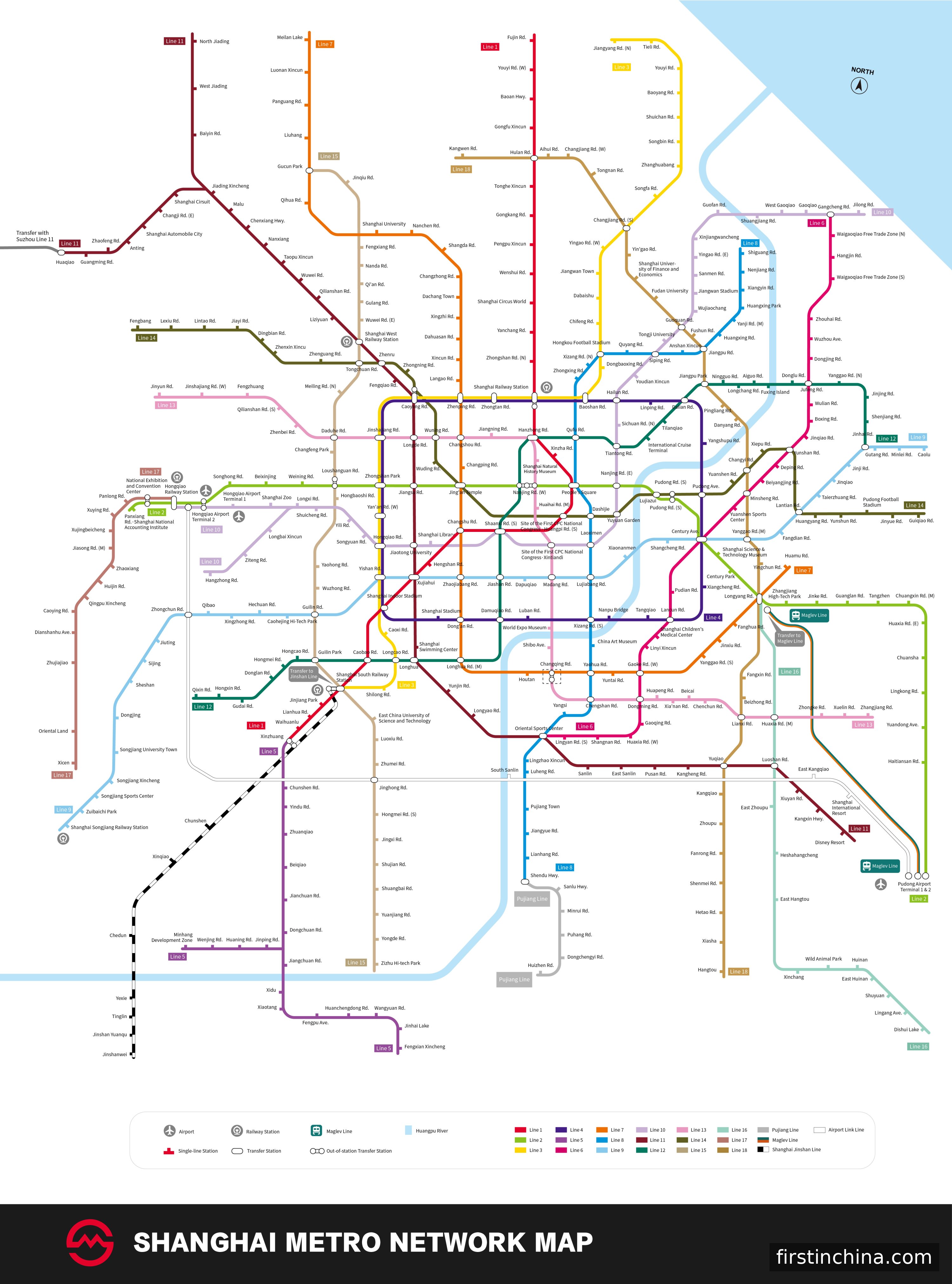
Shanghai’s network changes often, with new lines and extensions opening regularly, so a printed map in a guide goes out of date faster than in most cities. For the current network map, use the official Shanghai Metro network map on the operator’s English site: Shanghai Metro official network map (service.shmetro.com). In stations, the wall maps and the maps inside trains are bilingual and current, and the official Metro Daduhui app shows the full network, fares and train times.
Note on maps in other guides: the English-labelled Shanghai map most often reused online dates from about 2010 and does not show Lines 14–18 or the Airport Link Line, so we do not use that one. The map above is the newer TravelChinaGuide English version; the network changes often, so for the very latest lines check the official map linked above. If you print anything before you fly, print the official map, not an old third-party copy.
Paying for the metro and bus: Alipay, WeChat, cards and tickets
Set this up before your first ride, not at a busy turnstile. You have four workable options, in the order most first-timers find easiest.
1. Alipay transport QR code (recommended for most visitors). First set up Alipay itself — see how to set up Alipay for foreigners. Then, in Alipay, tap Transport, select Shanghai, and activate the metro transport code. At the gate, open the code and scan it at the turnstile scanner on entry and again on exit; the distance-based fare is calculated automatically. The same code also works on most Shanghai buses: scan it at the reader when you board. Using a QR code for two different transport modes (for example, metro then bus) within about two hours can earn a small discount on the second ride, according to local guides — check in-app on the day, as the rule can change.
2. WeChat transport QR code, or the Metro Daduhui app. First set up WeChat Pay — see how to set up WeChat Pay for foreigners. Then, in WeChat, go to Services, then Transport, select Shanghai, and activate the metro code; it works the same way at the gate. Shanghai Metro’s own app, Metro Daduhui, also generates a gate QR code and is worth downloading if neither Alipay nor WeChat works for your card. If one app fails for your foreign card, try the other before you buy a physical card; foreign-card acceptance and passport verification can differ between them, so check in-app on the day.
3. Shanghai Public Transportation Card. The rechargeable card works on the metro and buses and is sold at station service centres and ticket machines, usually with a refundable deposit of about ¥20. Tap in and tap out. This is the best fallback if your phone or foreign card does not cooperate, and it is also useful for a travelling companion who does not have a Chinese payment app. A China T-Union version of the card can also be used in other Chinese cities — ask at the service centre if you are travelling on to another city.
4. Single-journey tickets, day passes and contactless bank cards. Single-journey tickets are sold at station machines and counters, with an English interface at major stations. A 1-day pass costs about ¥18 and a 3-day pass about ¥45, each valid for unlimited metro rides from first use for 24 or 72 hours; both exclude the Maglev and some newer suburban railways, so confirm the exclusions when you buy. Contactless bank cards (UnionPay, Visa, Mastercard and others) can be used for tap-to-ride at many gates, but do not rely on a foreign card alone — keep an Alipay or WeChat code, or a transport card, as your backup.
Metro fares are distance-based: about ¥3 for up to 6 km, then about ¥1 more for each further 10 km. Most trips in the centre cost about ¥3–7. A 1-day pass pays off at roughly six rides in a day, and a 3-day pass at roughly four rides a day — if you are only taking two or three rides a day, pay per ride instead.
Buses: when they beat the metro
Shanghai’s bus network fills the gaps between metro stations, especially in the French Concession side streets, the Old City lanes and the suburbs. A bus wins when it goes directly where you want, without two metro changes, or when the metro station is a long walk from your hotel. A bus loses in rush-hour traffic, when the metro is almost always faster, and when you cannot read the stop names: bus stop signs are mainly in Chinese, and announcements are less consistently bilingual than on the metro.
To ride a bus: board at the front, scan your Alipay or WeChat transport code, or tap your transport card, at the reader near the driver. A short city bus ride usually costs about ¥2 — check the fare shown on the bus on the day. For a first-timer, the safest bus trips are short, direct ones you have already checked on a map app; for anything complicated, the metro or DiDi is usually less stressful. The Bund sightseeing tunnel, between the Bund and Lujiazui, is a tourist ride, not a practical transport option — it is slow, expensive for what it is, and the metro under the river is faster.
Taxis: how to hail, what to pay, what to avoid
Shanghai taxis are metered, plentiful outside rush hour, and useful for door-to-door trips, heavy luggage and late nights. Hail one on the street where it is legal to stop, or go to a taxi rank at an airport, station or hotel. At airports and stations, always use the official rank and ignore drivers who approach you inside the terminal offering a ride.
The meter starts at about ¥14 for a regular car, or about ¥16 for an electric car, for the first 3 km, then about ¥2.7 per km, with a 50% extra distance charge for the portion over 15 km and a 30% night surcharge roughly from 23:00 to 05:00. A typical central trip of a few kilometres costs roughly ¥20–40; from Pudong Airport to the centre, roughly ¥165–200 by meter depending on traffic and tolls. These are ranges, not quotes — traffic, route, vehicle type and tolls change the final figure.
Three rules prevent almost every taxi problem in Shanghai. First, make sure the meter is running before you move; if the driver offers a flat price instead, walk away and take the next car or a DiDi. Second, show the destination in Chinese characters from your hotel confirmation or a map app — most drivers do not read English addresses. Third, ask for a printed receipt when you get out; it records the car and the fare if you leave something behind or need to dispute a charge.
DiDi: the easy option when language is the problem
DiDi is China’s main ride-hailing app and, for most first-timers, the easiest way to get a car without explaining an address in Chinese. You set the destination in the app in English, see the fare estimate before you book, and pay in the app. This guide does not repeat the full tutorial: for step-by-step setup, booking, car types and payment, read how to use DiDi in China.
Use DiDi instead of a street taxi when: you have an exact English address or a pinned map location; it is raining, late, or you have luggage; or you are going to Disneyland, where a pre-booked car with a clear pickup point beats negotiating at a station. Use the metro instead of DiDi in weekday rush hour (roughly 07:00–10:00 and 16:00–19:00, when taxi peak surcharges can also apply), when a metro ride that takes 30 minutes can take over an hour by road. At airports, follow the signs to the designated ride-hailing pickup area, which is separate from the taxi rank.
Airport to the city, and station to the city
From Pudong Airport (PVG). Metro Line 2 runs under Terminals 1 and 2 to People’s Square in about 60–75 minutes, and on to Hongqiao; it is the cheapest default. The Airport Link Line is the faster option to the Hongqiao hub, in about 40 minutes for about ¥26. The Maglev runs from Longyang Road (Line 2) to Pudong Airport in about 8 minutes on a separate fare and ticket — it only saves time if you are already near Longyang Road, because you still need the metro to get there. A metered taxi to the centre costs roughly ¥165–200. A DiDi from the designated pickup area is usually in the same range.
From Hongqiao Airport (SHA). This is the easy airport: Terminal 2 is about a 5–10 minute walk to Hongqiao Railway Station, which is served by Lines 2, 10 and 17. From there, Line 2 reaches People’s Square and Lujiazui, Line 10 reaches the French Concession and the Old City, and Line 17 reaches Zhujiajiao. A taxi or DiDi to the centre is a short, cheap ride compared with Pudong — use it if you have heavy luggage.
From the high-speed stations. Hongqiao Railway Station is the main high-speed hub, on Lines 2, 10 and 17, and it shares a complex with Hongqiao Airport Terminal 2. Shanghai Railway Station is on Lines 1, 3 and 4, in the centre-north. Shanghai South Railway Station is on Lines 1, 3 and 15, in the south. Shanghai West Railway Station is on Line 11. In every case, the metro is inside or directly beside the station, and the station name on your ticket is the station you must go to — Hongqiao Railway Station, Shanghai Railway Station, Shanghai South and Shanghai West are different stations, far apart. Do not confuse Hongqiao Railway Station with Shanghai Railway Station: first-timers mix these two up more than any other pair in China.
Practical tips that save first-timers the most time
Avoid weekday rush hour on the metro if you can. Roughly 07:00–10:00 and 16:00–19:00 on weekdays, central lines are extremely crowded. Sightseeing is much more pleasant if you start after 10:00 or use DiDi for a short hop instead.
Check the last train, not the network closing time. Last trains differ by line, station and direction. The station display and the Metro Daduhui app show the last train for your exact route — check it before your last activity of the evening, especially after dinner in the French Concession.
Keep your hotel address in Chinese on your phone. Save a screenshot of the hotel name, address and a nearby metro station in Chinese characters. It solves taxi, DiDi and “ask a stranger” problems in one step.
Do not drag large luggage through rush-hour interchanges. For airport and station trips with big bags, take DiDi or a taxi, or travel outside rush hour. People’s Square and Century Avenue are the worst interchanges for luggage at peak times.
Use Line 2 as your spine, and branch off it. If you are ever lost, get back to Line 2: it connects Hongqiao, People’s Square, the Bund area (East Nanjing Road), Lujiazui and Pudong Airport. Almost every first-timer’s day can be rebuilt from a Line 2 station plus one change.
For the general rules that apply in every Chinese city — metro etiquette, DiDi versus taxi, and how transport codes work across cities — read how to get around Chinese cities.
Frequently asked questions
Can I use Alipay or WeChat to ride the Shanghai metro?
Yes, in most cases. Set up Alipay or WeChat Pay first, then activate the Shanghai metro transport code in Alipay under Transport, or in WeChat under Services then Transport, or use the Metro Daduhui app. Scan the code at the gate on entry and exit. If your foreign card is not accepted for the transport code, use a Shanghai Public Transportation Card instead, and check in-app on the day, as acceptance can change.
Which is faster from Pudong Airport: Line 2, the Airport Link Line, or the Maglev?
For most first-timers going to the centre, the Airport Link Line to Hongqiao, then the metro, is the fastest simple option, in about 40 minutes to Hongqiao. Line 2 is the cheapest and simplest, in about 60–75 minutes to People’s Square, with no change. The Maglev is only faster if you are already at Longyang Road, because you must take Line 2 there first and then change to the Maglev on a separate ticket.
Is a taxi or DiDi better in Shanghai?
For a first-timer who does not speak Chinese, DiDi is usually better: the destination is set in the app, the fare estimate is shown before booking, and payment is in-app. A street taxi is fine when the meter is running and you can show the address in Chinese characters. Avoid any car, taxi or otherwise, that refuses the meter or offers only a flat price.
How do I get to Disneyland by metro?
Take Line 11 to Disney Resort station. It is the last station on that branch, and the park entrance is a walk from the station. Allow a full day, and check the last train back before you enter the park, as the return metro can be crowded after the evening show.
What if the metro has stopped running?
Use DiDi or a taxi from a rank, and expect night rates on a taxi meter. Night buses exist on some routes, but they are harder to read without Chinese, so for a late arrival, a car is the safer default. If you are at an airport late at night, the airport taxi rank keeps running even after the metro stops — check the airport’s own signs for the current last departures.